




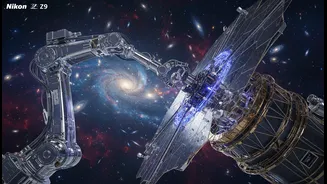


The Next Great Leap
The Habitable Worlds Observatory (HWO) is NASA's next planned flagship mission in astrophysics, a successor to the Hubble and James Webb Space Telescopes (JWST). Its primary goal is one of humanity's most profound questions: Are we alone? Scheduled for
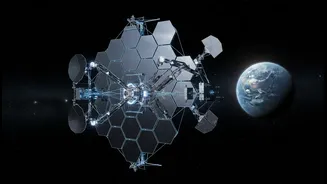
launch sometime in the 2040s, HWO will be the first observatory designed specifically to search for signs of life on planets orbiting other stars. Its main objective is to directly image and analyze the atmospheres of at least 25 potentially habitable, Earth-sized exoplanets. Using a suite of advanced instruments and an extremely powerful coronagraph—a tool for blocking the overwhelming glare of a host star—it will hunt for biosignatures like oxygen, methane, and ozone. But beyond its ambitious scientific goals, the HWO represents a fundamental shift in how we build and maintain our most precious eyes on the cosmos.
A Future-Proof Telescope
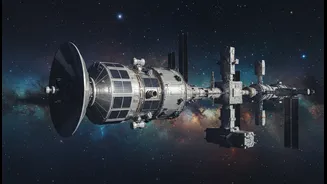
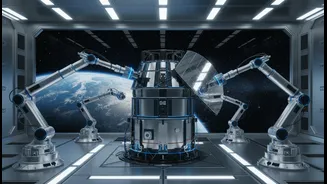
The most revolutionary aspect of the HWO mission is its built-in capability for servicing and upgrades. Unlike the James Webb Space Telescope, which was not designed to be serviced, NASA is mandating that HWO be built from the ground up with a modular architecture. This means critical systems—scientific instruments, computers, and other key electronics—will be configured as standardized, line-replaceable units. The plan is to send robotic spacecraft to the observatory to swap out old or degraded components with new, more advanced technology. This strategic pivot transforms the estimated $11 billion observatory from a single-lifecycle asset into a sustainable, upgradable platform that can evolve over decades. It ensures the HWO can benefit from technological advancements made long after its initial launch, preventing it from becoming obsolete.
Lessons from Hubble and Webb
NASA's experience with its previous great observatories heavily informs this new approach. The Hubble Space Telescope, launched in 1990 into low-Earth orbit, was famously designed for servicing. Five separate Space Shuttle missions allowed astronauts to correct its flawed primary mirror, replace gyroscopes, and install more powerful cameras and spectrographs. These upgrades have kept Hubble at the forefront of astronomy for over three decades. In stark contrast, the James Webb Space Telescope was sent to an orbit 1.5 million kilometers from Earth, a location known as Lagrange Point 2 (L2), which is far too distant for astronaut servicing missions. While Webb is a marvel of engineering, it is a fixed asset; what it launched with is what it will have for its entire operational life. HWO aims to combine the best of both worlds: Webb’s advantageous deep-space location with Hubble’s longevity through serviceability.
Robots to the Rescue
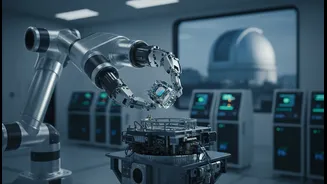
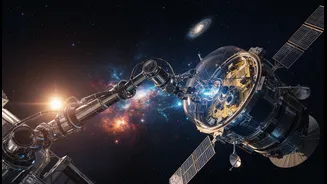
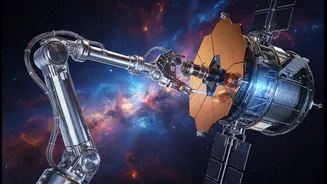
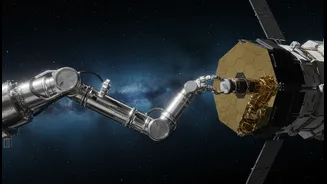
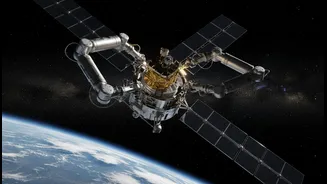
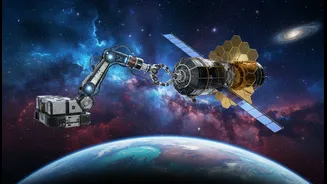
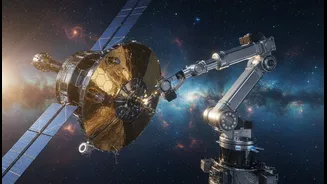
Since HWO will also operate at the distant L2 Lagrange point, human servicing missions are not feasible with current technology. This is where robots come in. NASA envisions autonomous or teleoperated servicing spacecraft capable of traveling to HWO, docking with it, and performing complex maintenance tasks. The observatory's design will include specialized docking interfaces, self-aligning connectors, and guide pins optimized for robotic manipulation. These robotic mechanics could replace an aging instrument with a next-generation version, repair damage from micrometeoroid impacts, or even perform an initial assembly of the telescope in space if its mirror is too large to fit in a single rocket fairing. This reliance on robotic servicing marks a major new chapter in space operations, leveraging a growing commercial sector dedicated to in-space servicing.
The Scientific Payoff
Designing for upgradability isn't just an engineering choice; it's a strategic decision to maximize scientific return. Technology for detecting and characterizing exoplanets is advancing rapidly. An instrument that is state-of-the-art in the 2040s could be surpassed a decade later. By building HWO as a serviceable platform, NASA ensures it can always be equipped with the best possible tools. If HWO makes a tantalizing discovery—perhaps faint signs of a biosignature on a nearby world—there will be immense motivation to quickly develop and install a new, more sensitive instrument to investigate further. This approach ensures that our most powerful tool in the search for life can adapt and improve, keeping it at the cutting edge of science for generations to come and providing an unprecedented return on a monumental investment.