



A New Cosmic Detective Agency
A group of UK-based astronomers has launched an innovative citizen science project called Black Hole Hunters. Hosted on the Zooniverse platform, it invites the public to help solve one of the galaxy's biggest mysteries: locating its millions of 'missing'
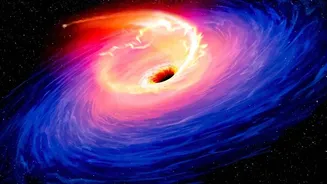
black holes. While scientists estimate that there could be over 10 million stellar-mass black holes in our galaxy alone, the actual number discovered is tiny. These objects are famously difficult to spot because their immense gravity traps all light, rendering them invisible. The Black Hole Hunters project aims to close this gap by crowdsourcing the immense task of data analysis, turning enthusiastic volunteers into cosmic detectives.
NASA's Unlikely Black Hole Tool
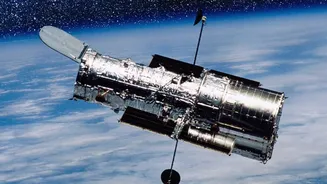
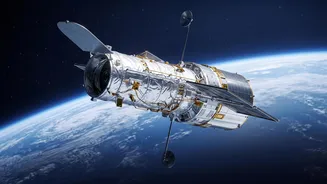
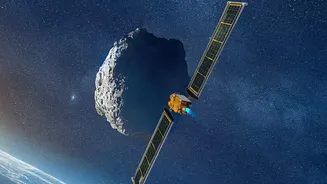
The key to this cosmic search is data from an unexpected source: NASA's Transiting Exoplanet Survey Satellite (TESS). TESS's primary mission, which began in 2018, is to find planets outside our solar system by monitoring the brightness of hundreds of thousands of stars. It looks for tiny, regular dips in a star's light, which can indicate a planet passing in front of it. However, this constant stream of high-precision brightness data is also perfect for spotting other cosmic events. For the Black Hole Hunters, this data provides the clues needed to find objects that cannot be seen directly. The project repurposes TESS's exoplanet-hunting prowess into a powerful tool for finding hidden black holes.
Searching for a Gravitational 'Flashlight'
Instead of looking for a dip in starlight, these cosmic detectives are searching for a sudden, characteristic brightening. The project focuses on finding black holes that are in a binary system, orbiting a normal star. If the alignment is just right from our perspective on Earth, the black hole will periodically pass in front of its companion star. When this happens, the black hole's intense gravity bends and focuses the light from the star behind it, acting like a cosmic magnifying glass. This effect, known as 'gravitational self-lensing', causes a distinct peak in the star's brightness. It's this temporary flash that serves as a tell-tale sign of an otherwise invisible companion. By identifying these unique light patterns, volunteers can flag potential black hole candidates for professional astronomers to investigate further.
The Power of the Crowd
The sheer volume of data produced by TESS is far too vast for a small team of scientists to sift through alone. Automated algorithms and AI are used to perform an initial sweep, identifying about one million potential candidates from millions of stars. However, AI can be easily fooled by other stellar phenomena, such as natural pulsations or flares, which can mimic a lensing event. This is where human intelligence becomes indispensable. The human eye is exceptionally good at pattern recognition and can distinguish the true, subtle signature of a black hole from background noise. Since its launch, nearly 23,000 volunteers have made over 12 million classifications, demonstrating the incredible power of collaborative, citizen-led science. No prior expertise is needed; volunteers are shown examples of what to look for and simply have to spot the right patterns.