


A Solar Mystery
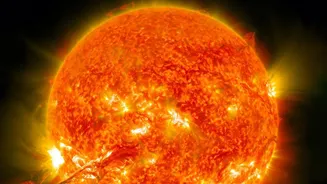
For decades, astronomers have been puzzled by a few key inconsistencies in our understanding of the Sun. Standard models of how stars like ours evolve don't perfectly match what we observe. For one, the Sun has a surprisingly low amount of the element
lithium on its surface. Lithium is a fragile element that gets destroyed at the high temperatures found inside stars, so its abundance is a key clue to a star's history. Additionally, there are subtle but persistent mismatches between the Sun's observed internal structure—measured through a field called helioseismology, which studies sound waves moving through the star—and what the models predict.
A Radical Hypothesis: A Cosmic Meal
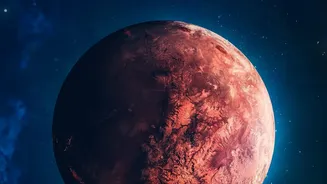
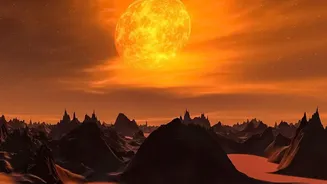
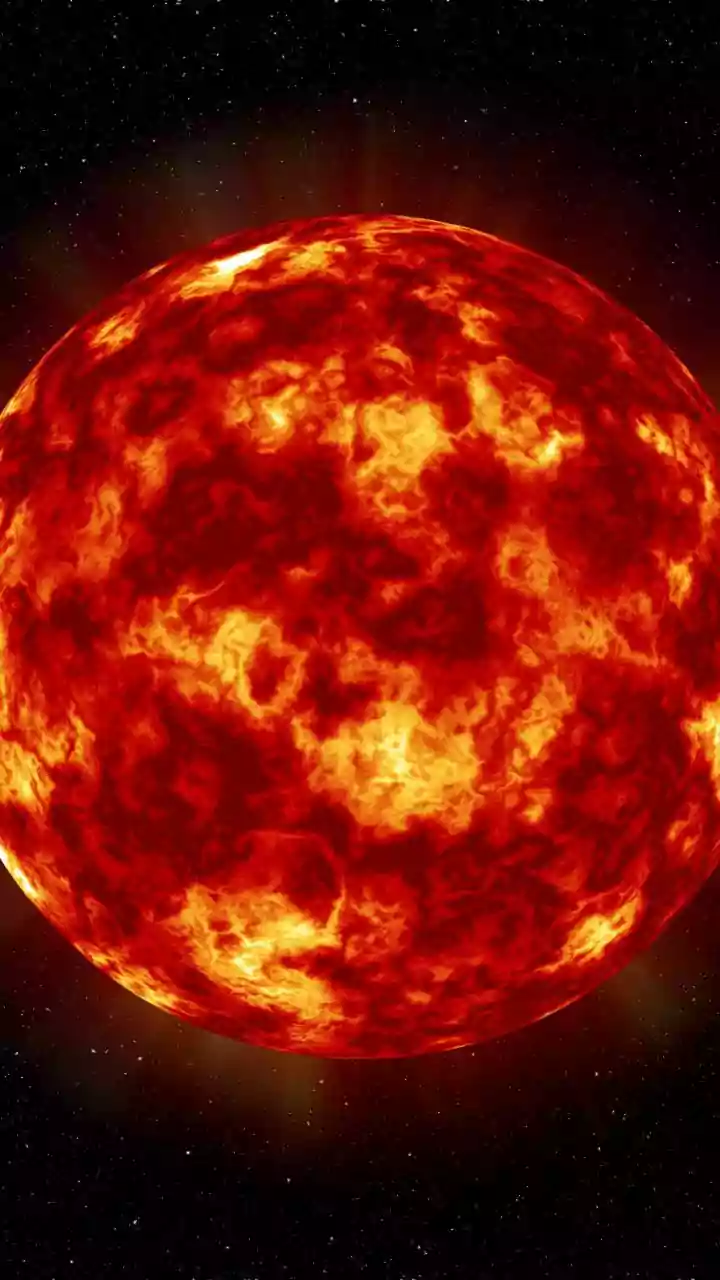
A new study published in the journal Monthly Notices of the Royal Astronomical Society proposes a dramatic solution to these puzzles: the young Sun ate a planet. According to computer simulations run by researchers, specifically Professor Mutlu Yildiz of Ege University in Turkey, the engulfment of a large rocky planet could account for these discrepancies. The models suggest a world between five and ten times the mass of Earth—a so-called 'super-Earth'—spiraled into the Sun during the chaotic early days of the solar system. As this planet was consumed, its chemically different materials mixed with the Sun's interior, leaving a lasting imprint.
The Hunt for Evidence
The theory isn't just speculation; it connects multiple pieces of evidence. The engulfment of a super-Earth simultaneously explains the Sun's low lithium levels and the subtle structural anomalies deep inside it. The models show that a dense, rocky planet could have plunged deep into the Sun before completely dissolving, altering the composition and structure in a way that aligns with modern observations. This also offers a potential answer to another long-standing question: why does our solar system lack a super-Earth, a type of planet that appears to be very common in other star systems? The answer might be that ours was consumed long ago.
Simulating a Star's Past
To test this hypothesis, scientists used advanced stellar evolution software to model the Sun's entire life, with and without a planet-snacking event. They ran scenarios where the young Sun accreted different types of material. The results showed that a scenario involving the ingestion of a super-Earth provided the best match for the Sun's current state, including its convection zone depth and sound-speed profile. Professor Yildiz noted that while they expected planetary engulfment to affect the Sun's structure, they were surprised the calculations pointed so specifically to a super-Earth within a particular mass range.
What This Means for Our Solar System
While the computer models provide strong circumstantial evidence, they don't definitively prove the Sun swallowed a planet. However, they offer a compelling, unified explanation for several previously disconnected solar mysteries. The research demonstrates that stars can preserve evidence of planets they destroy, turning them into chemical and structural time capsules. Future work will involve refining observations using helioseismology to search for the specific structural and chemical 'fingerprints' predicted by the engulfment models. Whether our Sun is confirmed to be a planetary cannibal or another process is found to explain its quirks, the investigation is pushing our understanding of how stars and their planets co-evolve, often in violent and dramatic ways.