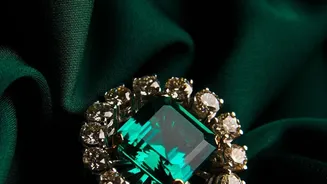








A Legend in Green and White
In the opulent world of 17th-century Mughal India, two pairs of spectacles were crafted that were unlike any others in history. Known today as the 'Gate of Paradise' and the 'Halo of Light', their lenses were not made of glass, but of astonishingly large
gemstones. The 'Gate of Paradise' featured two drop-shaped lenses carved from a single Colombian emerald, believed to have originally weighed over 300 carats. Its counterpart, the 'Halo of Light', had lenses cleaved from a single flawless diamond from the Golconda mines, estimated to have been over 200 carats. For centuries, their existence was the stuff of legend, tied to powerful emperors like Shah Jahan. The assumption was simple: these were the ultimate luxury sunglasses, designed to correct vision or perhaps shield royal eyes from the sun.
The Ancient Idea of Gemstone Vision
The belief that emeralds could be used for vision was not new. The Roman historian Pliny the Elder wrote in the 1st century AD that Emperor Nero would watch gladiatorial games through a 'smaragdus', the Latin term for a green gem. For generations, this was interpreted as Nero using an emerald as a lens to correct his nearsightedness or reduce glare. This anecdote provided a historical precedent for the Mughal spectacles; if a Roman emperor used an emerald to see, why not a Mughal emperor? The objects were framed as the pinnacle of optical technology, combining immense wealth with practical function. However, the original frames were lost, and the lenses were reset into new, diamond-studded frames in the 19th century, obscuring their original form and adding another layer to the mystery.
A New Science of Seeing
The 19th century brought a revolution not in eyewear, but in understanding the very materials of the earth. The field of gemology transformed from a loose collection of lore into a hard science. Scientists could now precisely measure a mineral's properties: its hardness, its chemical composition, and, most importantly, its optical characteristics. Diamonds, as the hardest known substance with an exceptionally high refractive index of 2.42, became the benchmark for brilliance and clarity. This new scientific framework allowed for a rigorous comparison of gemstones. When the properties of emeralds were analysed, a different picture emerged. While beautiful, emeralds have a much lower refractive index (around 1.57) and are famous for their natural inclusions, known as a 'jardin' or garden. These properties, which give the stone its soft, velvety glow, make it a terrible material for lenses. Looking through an emerald would result in a blurry, distorted view.
Spiritual Aids, Not Visual Aids
The scientific insights of the 19th century effectively shattered the old interpretation. The Mughal spectacles were not functional eyewear. So, what were they? The answer lay not in optics, but in culture and belief. In both Islamic and Indic traditions, gemstones were imbued with powerful mystical properties. The very name of the emerald pair, 'Gate of Paradise', points to its true purpose. Green is a sacred color in Islam, associated with paradise, eternal life, and healing. It was believed that looking through these emeralds was not about seeing the world more clearly, but about gaining a spiritual vision—a glimpse of paradise, a way to ward off evil, or a tool for meditation and enlightenment. The diamond lenses of the 'Halo of Light' were similarly symbolic, with diamonds representing divine light and the presence of God.
Reframing a Priceless Treasure
The story of the Mughal spectacles is a perfect example of how scientific advancement can deepen our understanding of history. The rigorous study of gems, with diamond as a key point of reference, didn't diminish the value of the emerald lenses—it enriched their meaning. What were once seen as primitive, if impossibly lavish, sunglasses were reframed as sophisticated tools for spiritual contemplation. They weren't meant to correct physical sight but to enhance inner vision. This reinterpretation reveals that the Mughal patrons who commissioned them were not just investing in luxury, but in objects of profound spiritual significance. The incredible technical skill required to slice such enormous gems without shattering them was deployed not for a practical goal, but for a transcendent one.