


A Cosmic Tipping Point
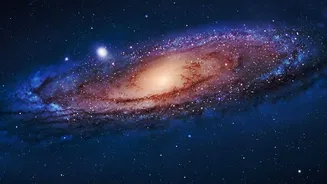
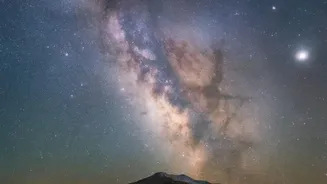
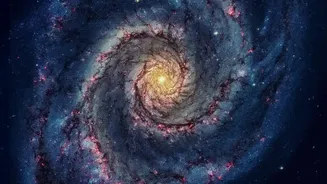
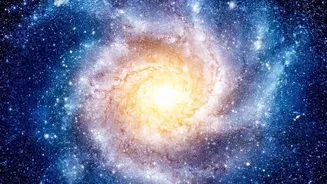
Imagine our home galaxy, a vast spinning disc of stars, dust, and gas, being knocked completely onto its side. That’s the stunning scenario proposed by astronomers from Durham University, who presented their findings at the Royal Astronomical Society's
National Astronomy Meeting. Using sophisticated supercomputer simulations, they concluded that the Milky Way likely underwent a dramatic reorientation, changing its alignment by more than 90 degrees. This cosmic somersault wasn't a sudden event but a gradual tipping that unfolded over billions of years, driven by the immense gravitational forces of a galactic merger. This theory helps explain a long-standing puzzle: why the vast, sparse cloud of ancient stars surrounding our galaxy’s main disk, known as the stellar halo, rotates much more slowly than expected.
The Prime Suspect: Gaia-Sausage-Enceladus
The culprit behind this colossal flip is thought to be a massive dwarf galaxy known as Gaia-Sausage-Enceladus. This galaxy, nicknamed for the sausage-like shape its scattered stars now form, smashed into our own in a massive, head-on collision between 8 and 11 billion years ago. The Milky Way, being far more massive, absorbed its smaller rival in what is considered the most significant merger in our galaxy's early history. The merger was so violent that it completely reshaped the young Milky Way, scattering billions of stars from the consumed galaxy into elongated orbits that now populate our stellar halo. Scientists believe the gravitational torque from this powerful impact is what initiated the slow, momentous flip of the entire galactic disk.
How Science Cracked the Case
Astronomers couldn't directly witness an event that happened billions of years ago. Instead, they acted as cosmic detectives, piecing together clues. A key piece of evidence came from the European Space Agency's Gaia space telescope, which is meticulously mapping the positions and movements of over a billion stars. Gaia's data revealed the oddly slow rotation of the stellar halo. To understand why, researchers used the Auriga suite of cosmological simulations to model the evolution of galaxies similar to our own. The simulations showed a clear pattern: galaxies that experienced a major head-on collision, just like the one with Gaia-Sausage-Enceladus, were the ones whose disks had flipped and whose stellar haloes were rotating slowly. The simulation results provided a compelling explanation for the real-world observations from Gaia.
Ripples Through Spacetime
The collision with Gaia-Sausage-Enceladus was just one part of our galaxy's turbulent history. The Milky Way is also in an ongoing collision with another dwarf galaxy, the Sagittarius dwarf galaxy, which has smashed through our galactic disk at least three times over the past six billion years. These repeated impacts didn't flip the galaxy, but they did send massive ripples, or waves, through its structure, much like a rock thrown into a pond. These ripples have warped our galaxy’s disk, which is why it isn't perfectly flat, and have triggered massive bursts of star formation. In fact, some scientists suggest that one of these waves, caused by a pass-through of the Sagittarius galaxy, could have compressed the gas and dust cloud that ultimately formed our own Sun about 4.6 billion years ago.
A New Understanding of Our Galactic Home
This discovery fundamentally changes our picture of the Milky Way from a relatively stable, serene structure to a dynamic and evolving system shaped by violent encounters. The fact that our galaxy may have flipped on its side means that most of its stars, possibly even our own Sun, once moved on entirely different paths than they do today. This suggests our 'stable' corner of the cosmos might not have been so stable for the Solar System's entire lifetime. Understanding this tumultuous past not only solves the mystery of the slow-spinning halo but also provides crucial insights into how large spiral galaxies like ours are assembled over billions of years through mergers and acquisitions of smaller galaxies.