

Two Missions, One Star
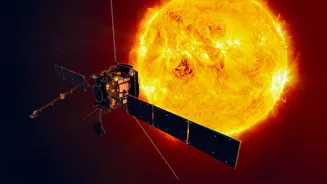
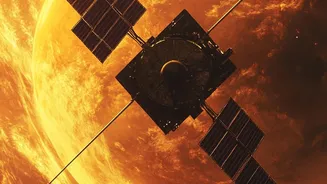
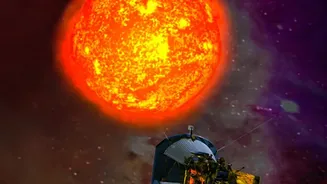
India's first dedicated solar mission, Aditya-L1, has been a source of national pride since its launch in September 2023. From its strategic vantage point at Lagrange point 1 (L1), it maintains an uninterrupted watch over the Sun. A key instrument onboard
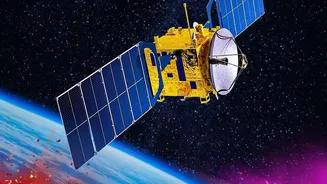
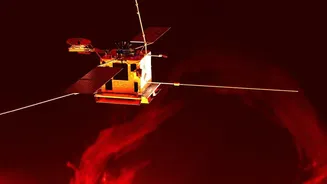
is the Visible Emission Line Coronagraph (VELC), developed by the Indian Institute of Astrophysics. A coronagraph is a specialized telescope designed to block out the Sun's overwhelming glare, allowing scientists to study its much fainter outer atmosphere, the corona. VELC does this by analysing the light spectrum, which helps determine the temperature, velocity, and density of the coronal plasma. Joining this effort is the European Space Agency's (ESA) Proba-3, a mission that was itself launched by an ISRO PSLV rocket in December 2024. Proba-3 is a pioneering mission demonstrating a technique called formation flying. It consists of two separate spacecraft flying in perfect alignment about 150 meters apart. One craft acts as an 'occulter', casting a precise shadow onto the other, which carries the coronagraph. This creates a near-perfect artificial eclipse in space, enabling incredibly clear images of the Sun's inner corona.
A Powerful Partnership
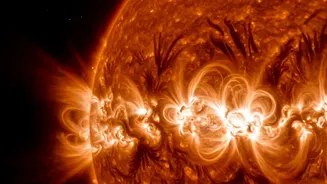
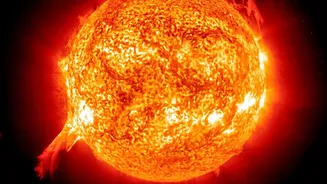
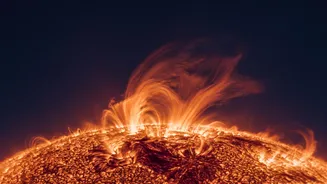
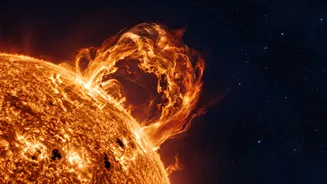
For the first time, scientists have combined observations from Aditya-L1's VELC and Proba-3's ASPIICS coronagraph to study the same solar events. This collaboration, led by researchers at the Indian Institute of Astrophysics in Bengaluru, provides a more complete picture than either mission could achieve alone. While Proba-3's ASPIICS instrument captures sharp, detailed images of a solar eruption's shape and motion, Aditya-L1's VELC provides spectroscopic data, revealing the temperature and density of the plasma within the eruption. The joint study focused on two Coronal Mass Ejections (CMEs) that occurred in September 2025. CMEs are massive explosions that hurl billions of tonnes of magnetised plasma from the Sun into space. One of the observed CMEs was fast, travelling at roughly 645 km/s, while the other was much slower at 145 km/s. By combining the imaging data from Proba-3 with the spectroscopic data from Aditya-L1, scientists could cross-check their calculations and build a more robust, multi-dimensional understanding of how these eruptions begin.
How to Weigh a Solar Storm
Measuring the mass and density of a CME right after it erupts has long been a challenge for solar physicists. These early moments are critical for understanding the energy that drives the eruption and how it will evolve as it travels through space. Earlier instruments often struggled to see the faint, early stages of these events close to the Sun's bright disk. The synergy between Aditya-L1 and Proba-3 helps overcome this. Proba-3's ASPIICS provides a clear view of the CME's structure, allowing scientists to estimate its volume and, from that, its mass and kinetic energy (the energy of its motion). Simultaneously, Aditya-L1's VELC measures properties of the hot gas, providing independent estimates of the plasma's density and thermal energy. Scientists were encouraged to find that the mass and energy estimates derived independently from both instruments showed good agreement, boosting confidence in the accuracy of their measurements.
Why This Research Matters for India
Understanding CMEs is not just an academic exercise; it's a crucial part of space weather forecasting. When a powerful CME is directed at Earth, it can trigger geomagnetic storms that pose a significant threat to our technology-dependent society. These storms can disrupt satellite operations, interfere with GPS and communication networks, and even cause large-scale power outages on the ground. As India continues to expand its satellite fleet and space-based infrastructure, the ability to predict and mitigate the effects of space weather becomes increasingly vital. This joint research demonstrates Aditya-L1's key role in the global effort to better understand the Sun's behaviour. The success of this collaboration not only elevates the scientific impact of the Aditya-L1 mission but also showcases ISRO's growing prominence as a key partner in international space science.