



A Cosmic Puzzle in the Halo
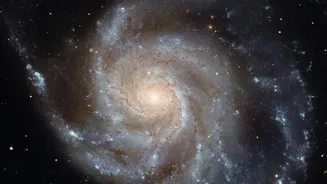
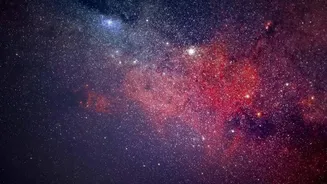
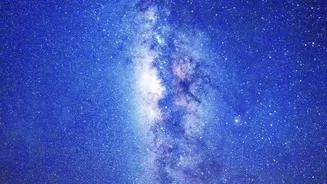
Surrounding the bright, flat disc of the Milky Way that we are all familiar with is a vast, sparse sphere of ancient stars called the stellar halo. Think of it as a faint, ghostly cloud enveloping the main galaxy. For years, astronomers have been puzzled
by this halo. While stars in the main disc, like our Sun, zip around the galactic centre at about 220 kilometres per second, the stars in the halo move much more slowly, at only about 25 kilometres per second. This discrepancy has been a long-standing mystery. The halo is largely made up of stars captured from smaller galaxies that the Milky Way has consumed over billions of years, so its behaviour holds clues to our galaxy's chaotic past. The slow rotation suggested a piece of the story was missing.
The Prime Suspect: A 'Sausage' Galaxy
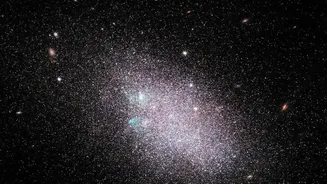
The key to this mystery appears to be a major cosmic crash that happened long before the Earth was formed. About 10 billion years ago, a dwarf galaxy slammed head-on into the young Milky Way. This galaxy, now known to astronomers as Gaia-Sausage-Enceladus (or simply the Gaia Sausage), was torn to shreds in the collision, and its stars were absorbed into our own galaxy's halo. Evidence for this ancient merger was first uncovered in 2018, thanks to data from the European Space Agency's Gaia mission, which tracked the motion of billions of stars. It found a distinct group of stars moving in unusual, highly elongated orbits, like a sausage shape, which were the tell-tale remnants of the devoured galaxy.
The Galactic Flip Theory
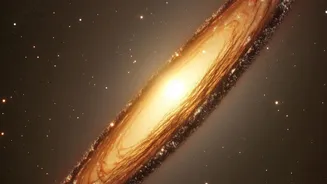
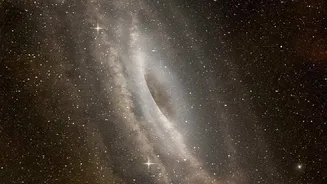
This is where the new theory comes in. Researchers from Durham University used powerful supercomputer simulations to see what happens when a Milky Way-like galaxy experiences a head-on collision like the one with the Gaia Sausage. Their models showed that such an impact could exert a massive gravitational torque, causing the entire galactic disc to slowly wobble and change its orientation over hundreds of millions of years. This isn't a sudden flip, but a gradual, epic reorientation—a 'disc flip'—of more than 90 degrees. In the simulations, galaxies that experienced both a major head-on collision and a subsequent disc flip ended up with the same kind of slowly rotating stellar halo that we observe in the Milky Way today.
What This Means for Us
This discovery does more than just solve the puzzle of the slow halo; it fundamentally changes our understanding of the Milky Way's life story. It suggests our galaxy has had a far more dynamic and violent history than previously thought. The orientation we see today is not how the galaxy was originally aligned. A 'disc flip' means that most of the stars in our galaxy, possibly even our own Sun, once moved on very different paths. According to lead researcher Kirill Batrakov, this adds a new and crucial chapter to the story of our cosmic home, one that must be considered when comparing the Milky Way to other galaxies. The theory also provides a new framework for understanding the invisible dark matter halo that surrounds our galaxy, as its motion seems to be linked to the stellar halo's rotation.