






A Tiny Bomb in Every Droplet
It might be hard to believe that something as soft as a water droplet can damage hard materials like rock or concrete. Yet, researchers have finally measured the hidden forces at play. A recent study from the University of Minnesota has shed new light
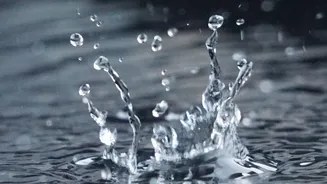
on this age-old question. Using a novel technique called high-speed stress microscopy, scientists were able to measure the exact pressure and shear stress created when a liquid droplet hits a solid surface. The results were startling. They found that upon impact, the spreading edge of the droplet moves faster than the speed of sound, creating a powerful shock wave that radiates across the surface. This effect means each individual raindrop behaves like a microscopic bomb, releasing its impact energy explosively. This discovery provides the first quantitative explanation for why raindrops can cause erosion on hard surfaces over time.
More Than Just a Simple Splash
For decades, our understanding of rain erosion primarily focused on what is known as 'splash erosion'. This process, critical in agriculture, describes how raindrops hitting bare soil act like tiny hammers, dislodging particles and making them easy for runoff water to carry away. A single heavy storm can splash as much as 90 tons of soil per acre, clogging soil pores, increasing runoff, and leading to significant topsoil loss. This process is well-documented and understood. However, the new research goes a step further. It isn't just about displacing loose particles like sand or soil; it explains the mechanism that can initiate wear on solid, non-porous materials. The supersonic shockwave is a fundamentally different process from a simple splash, providing the missing piece of the puzzle for how slow surface wear on hard materials actually begins.
The Cumulative Power of Slow Wear
The force from a single droplet is, of course, minuscule. You won't see a crack form from one drop of rain. The true power lies in repetition and time. The study underscores the importance of 'slow wear'—a gradual process of degradation caused by countless tiny impacts. Each explosive shockwave contributes an infinitesimal amount of damage, but when multiplied by the billions of drops in a single monsoon season, and then across decades or centuries, the cumulative effect is enormous. This is how seemingly permanent structures slowly degrade. It’s a relentless, patient force that chips away at infrastructure, natural rock formations, and cultural heritage sites. Understanding this slow, persistent mechanism is crucial because it often goes unnoticed until significant damage has already occurred.
Why It Matters for India's Infrastructure and Heritage
In a country like India, where the annual monsoon brings intense and prolonged rainfall, these findings are especially relevant. The nation’s vast network of roads, bridges, and concrete buildings are constantly subjected to this erosive force. Prolonged water exposure is known to weaken the binding agents in asphalt and seep into the cracks in concrete, leading to potholes and structural decay. The new study explains the very first step in this process of degradation. Furthermore, India is home to countless ancient temples and monuments carved from stone. These invaluable pieces of cultural heritage have withstood the elements for centuries, but they are not immune to the slow wear of raindrop impacts. The explosive force of each drop contributes to the gradual erosion that wears away intricate carvings and weakens ancient structures, making their preservation an ongoing battle against this natural force.
Engineering a More Resilient Future
This research is not just an academic curiosity; it has profound practical implications for engineering and materials science. By understanding the precise mechanism of droplet erosion, engineers can now work on developing more resilient materials. The study's authors suggest this knowledge could lead to the design of surfaces with enhanced erosion resistance. The applications are widespread, ranging from creating more durable concrete and asphalt for roads to developing protective coatings for wind turbine blades, which are known to erode under the constant barrage of rain. It could even inform the design of aircraft components and other technologies exposed to the elements. By grasping the physics of the problem, we can begin to engineer better solutions to counteract it.