

In the grand tapestry of the Ramayana, few names are as instantly recognizable as Ravana. But beyond his infamous deeds, what does his name actually mean? The story is not just a simple definition, but an epic tale of arrogance, power, and devotion.
The Sound of a Roar
At
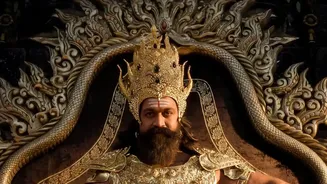
its core, the name Ravana finds its origin in the Sanskrit root word 'ru', which means 'to roar' or 'to cry out'. Combined with a suffix, Ravana translates to 'the one who roars' or 'he of the terrifying roar'. This etymology perfectly captures the essence of the formidable Rakshasa king of Lanka, a character whose powerful presence and booming voice were said to shake the very heavens. It reflects not just his physical might, but the terror he inspired in his adversaries. This name, however, was not given to him at birth. It was earned in a moment that would define his relationship with the divine for the rest of his life.
A Test of Pride at Mount Kailash
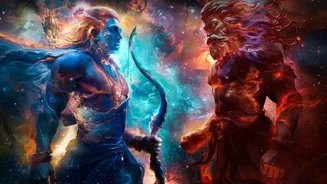
The most famous legend behind his name involves an audacious act of hubris. Originally known as Dashagriva or Dashanana, meaning 'the ten-headed one', the king of Lanka was flying in his celestial chariot, the Pushpaka Vimana, when his path was blocked by Mount Kailash, the sacred abode of Lord Shiva. Annoyed and arrogant, Dashagriva decided not to go around the mountain, but to uproot it entirely. He placed his mighty arms beneath the peak and began to lift. As the mountain trembled, a calm Lord Shiva simply pressed down with his big toe, trapping Dashagriva's hands beneath the immense weight.
A Cry That Named a King
Caught and in excruciating pain, Dashagriva let out a scream so powerful it was said to have shaken all three worlds. It was this deafening, earth-shattering cry that earned him his new name. Impressed by the sheer power of his roar, and later by his devotion as he sang hymns to ask for forgiveness, Lord Shiva himself bestowed the name 'Ravana' upon him. The name became both a mark of his formidable power and a permanent reminder of his arrogance being humbled by a divine force. In this one act, his identity was forged: a being capable of shaking the cosmos with his cry, yet ultimately subservient to a higher power.
Dashanana: The Ten-Headed Scholar
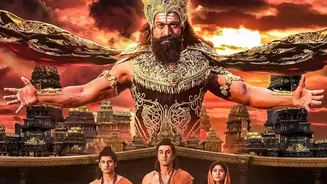
While 'Ravana' speaks to his power and pride, his birth name, Dashanana, points to his intellectual prowess. The ten heads are often interpreted not just as a physical feature but as a symbol of his vast knowledge. It is said they represent his mastery of the four Vedas and the six Shastras, making him one of the most learned scholars of his era. Other interpretations suggest the ten heads embody negative human emotions like lust, anger, greed, and ego, which ultimately contributed to his downfall. This duality is central to his character: a brilliant mind coexisting with fatal flaws.
A Name's Lasting Echo
Beyond Ravana and Dashanana, he was also known by other titles like Lankeshwara ('Lord of Lanka'), reflecting his status as a capable and powerful ruler. Each name peels back another layer of this complex character. However, it is the name Ravana that endures most powerfully. It encapsulates the core of his being — immense strength, a voice that commands attention, and a pride so great it challenged the gods. The story of his naming is a microcosm of his entire life story: a pursuit of power that leads to a painful confrontation with dharma, followed by a display of devotion, and ultimately, a fate sealed by the very same pride that gave him his legendary roar.