

The Cosmic Engine of a Supernova
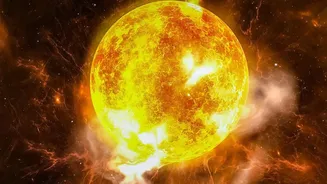
When a star many times more massive than our sun runs out of fuel, it can no longer support its own immense weight. Gravity wins, and the star's core implodes in a fraction of a second. This catastrophic collapse triggers an outward-moving shockwave.
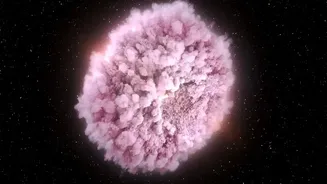
In a successful supernova, this shockwave is powerful enough to blast the star's outer layers into space, creating a spectacular explosion and leaving behind a dense remnant like a neutron star. For decades, astrophysicists have tried to perfect their models of this process, but a key question has always been what gives the shockwave the final, critical push it needs to succeed. A tremendous amount of energy is required, and the engine for this is thought to be neutrinos.
Meet the Ghost Particle
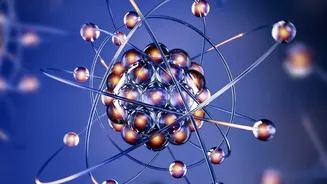
Neutrinos are fundamental particles that are almost massless, have no electric charge, and barely interact with other matter. Trillions of them pass through your body every second without you noticing. They are created in nuclear reactions, including those inside stars. During a core-collapse supernova, an unimaginable flood of neutrinos is released, carrying away about 99% of the collapse's energy. While they rarely interact, their sheer numbers mean that a small fraction will slam into the material just outside the star's core, heating it up. This neutrino heating is the key mechanism believed to power the shockwave and drive the explosion. Without it, the star would likely just collapse into a black hole.
A Matter of Three Flavours
Neutrinos come in three types, or 'flavours': electron, muon, and tau. Scientists have known for years that neutrinos can switch between these flavours as they travel, a process called oscillation. However, it was long assumed that within the incredibly dense environment of a collapsing star, this flavour-changing would be negligible and have little effect on the outcome. Electron neutrinos interact with matter more readily than muon or tau neutrinos. This distinction is crucial, as the ability of the neutrino flood to transfer energy and power an explosion depends heavily on what flavour they are and how they interact with the surrounding stellar plasma.
The 'Fast Conversion' Twist
A recent study published in the journal Physical Review D has challenged old assumptions. Researchers from the University of Copenhagen found that under the extreme conditions deep inside a supernova, neutrinos can interact with each other so intensely that they trigger 'fast flavour conversions'. This isn't the slow oscillation over vast distances, but a rapid, almost instantaneous switch happening on scales as small as a few centimetres. This phenomenon had been theorized, but its impact on whether a star actually explodes was not fully understood, partly because it is incredibly complex and computationally expensive to model. The new research used simplified models to simulate the collapse of 195 stars, ranging from nine to 120 times the mass of our sun, to see what would happen when fast conversions were included.
Stealing a Supernova's Thunder
The results of the simulations were dramatic. Including fast flavour conversions caused a significant number of stars, which were predicted to explode in standard models, to instead fail and collapse directly into black holes. The effect was particularly strong for stars between 16 and 30 times the mass of the sun. The 'flavour' of a neutrino dictates how it interacts with the star's material. By rapidly changing the mix of flavours, these conversions can alter the flow of energy. If too many electron neutrinos, which are better at pushing matter, turn into other flavours that interact less, the shockwave can lose its momentum. The energy that was supposed to power the explosion is effectively siphoned away, and the shockwave stalls, dooming the star to become a black hole.
Solving a Cosmic Discrepancy
This research could help solve several long-standing puzzles in astrophysics. For instance, astronomers observe fewer supernovas in the universe than theoretical models predict. If many massive stars are failing to explode and are instead collapsing quietly into black holes, it would help explain this 'supernova rate problem'. It might also explain why astronomers have seen some very large stars seemingly vanish without a trace, and why some detected neutron stars have lower masses than expected. The findings suggest that the fate of a massive star—whether it ends in a brilliant explosion or a silent collapse—is delicately tied to the quantum behaviour of its most ghostly particles.