




From Tech Demo to Science Scout
The success of the Ingenuity Mars Helicopter, which completed 72 flights over nearly three years, fundamentally changed our approach to planetary exploration. It proved that powered, controlled flight is achievable in the thin Martian atmosphere, a feat
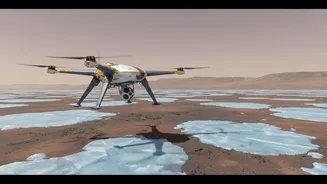
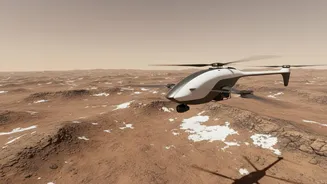
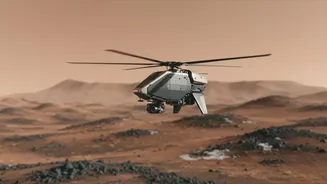
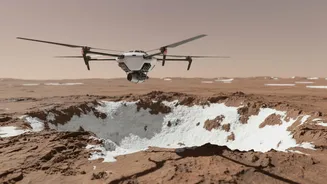
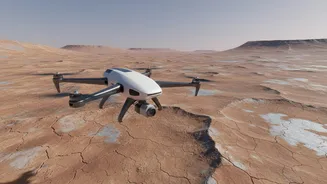
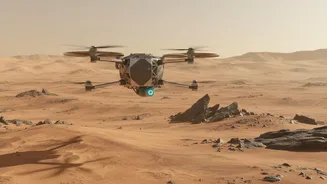
many once considered impossible. Ingenuity was primarily a technology demonstration, a scout armed with a simple camera. Its success, however, paved the way for more ambitious concepts: flying science laboratories that can go where rovers cannot and do what orbiters cannot. The Skyfall mission concept, being developed at NASA's Jet Propulsion Laboratory (JPL), represents this next generation of aerial explorers. Instead of one small helicopter, Skyfall envisions sending a team of three advanced rotorcraft to Mars, each carrying a suite of scientific instruments.
What is the Skyfall Concept?
The Skyfall mission proposes to deploy three autonomous helicopters that are more capable than their predecessor. Unlike Ingenuity, which was deployed from the belly of the Perseverance rover, the Skyfall helicopters are designed for a daring mid-air deployment, landing themselves on the Martian surface without a rover's assistance. These next-generation aircraft are expected to carry multiple instruments, including high-resolution cameras and weather sensors. But the star of the show is a specially designed ground-penetrating radar (GPR) system. The primary objective is to use this GPR to hunt for one of the most sought-after resources on Mars: subsurface water ice. A launch for the mission is proposed for late 2028.
Peering Beneath the Dust
Ground-penetrating radar works by sending radio waves into the ground and listening for the echoes that bounce back. Different materials, such as rock, sand, and ice, reflect these signals in distinct ways, allowing scientists to create a map of the subsurface. While orbiters have used radar to map deep ice deposits, particularly at the poles, they can't resolve the first few meters just below the surface in fine detail. Rovers with GPR, like ESA's upcoming ExoMars rover, can provide this detail but are limited by their slow speed and inability to cross difficult terrain. A helicopter flying low and slow over the landscape offers a revolutionary solution, bridging the gap between orbital and ground-based observations.
The 'Cape' and Its Purpose
To make GPR work on a small, lightweight helicopter, engineers at JPL had to get creative. The result is a unique, flexible antenna that looks like a small cape or tail hanging below the aircraft. This fabric-based antenna needs to be long enough to function effectively but also resilient enough to bend and drag during landing without breaking. During recent tests, engineers demonstrated that the antenna could withstand the pressures of landing on uneven, rocky surfaces and spring back into its correct shape for data collection upon takeoff. According to Adrian Tang, the GPR lead at JPL, this low-and-slow aerial approach is the only way to remotely detect shallow ice and map its fine layers. The radar is designed to see up to 16 feet (about 5 meters) below the Martian dust.
Why Finding Ice Matters
The search for subsurface ice is a top priority for NASA. From a scientific perspective, ice deposits are like time capsules, preserving a record of Mars's past climate and offering clues about whether the planet could have once supported life. For future human exploration, accessible water ice is a game-changing resource. Astronauts on Mars could potentially process it to create drinking water, breathable oxygen, and even rocket fuel. By mapping the extent and depth of these ice deposits, the Skyfall concept could help identify the best landing sites and resource depots for the first human missions to the Red Planet. This makes the mission not just one of scientific discovery, but also a critical step in preparing for a human presence on Mars.