

The 'Failed Stars' of the Cosmos
Imagine an object that begins its life just like a star, born from a collapsing cloud of gas and dust. It gathers mass, its core growing hotter and denser. But then, it just stops short. It never gets massive enough to ignite the sustained nuclear fusion
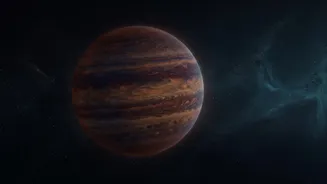
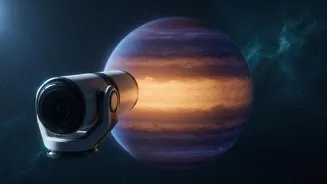
of hydrogen that makes stars shine. This is a brown dwarf. Often called 'failed stars', they occupy a mysterious middle ground, typically having a mass that is somewhere between 13 and 80 times that of Jupiter. While they are not stars, they aren't exactly planets either, leading astronomers on a quest to understand their unique place in the universe.
Drawing the Line in Space
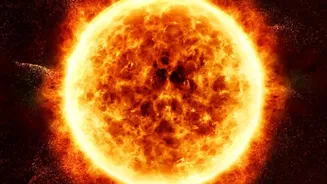
So, what truly separates a brown dwarf from a large planet like Jupiter or a small star? The answer lies in nuclear fusion. Stars are defined by their ability to fuse hydrogen into helium in their cores. Planets can't do this at all. Brown dwarfs are caught in the middle. They aren't massive enough for hydrogen fusion, but most are just big enough to briefly fuse deuterium, a heavier type of hydrogen, early in their lives. This deuterium-burning capability is the key distinction that separates them from giant planets. The line between a brown dwarf and a small, cool star is mass. An object needs to be about 80 times Jupiter's mass, or 8 percent of the Sun's mass, to kickstart and maintain hydrogen fusion and earn the title of 'star'. Below that threshold, it remains a brown dwarf, destined to cool and fade over billions of years.
How NASA's Telescopes Find Them
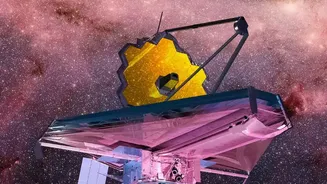
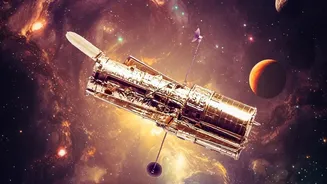
Studying brown dwarfs is tricky because they are incredibly dim. Having failed to become stars, they don't produce their own light and mostly emit faint, warm glows in the infrared spectrum. This makes them nearly invisible to standard telescopes. To hunt these elusive objects, NASA relies on powerful infrared observatories. Telescopes like the recently launched SPHEREx and, most notably, the James Webb Space Telescope (JWST) are perfect for the job. Their sensitive instruments can peer through cosmic dust and detect the faint heat signatures of these cool, cloudy worlds, allowing scientists to analyse their atmospheres and solve the puzzle of their composition.
Webb's Revolutionary Discoveries
Recent findings from the James Webb Space Telescope are revolutionising our understanding. By observing a nearby star-forming region called IC 348, astronomers have found brown dwarfs with masses as low as just two to four times that of Jupiter. This discovery challenges existing theories on how stars—and by extension, brown dwarfs—form, as it was previously thought that the process of cloud collapse couldn't create such small objects. Even more surprising, scientists found evidence that one of these tiny, planet-mass brown dwarfs has a disk of gas and dust swirling around it—the very same kind of disk that forms planets around stars. This raises the tantalising possibility that an object the size of a planet could itself be host to its own planetary system. These findings from Webb are blurring the lines between planets and stars more than ever before.