



More Than Just a Game
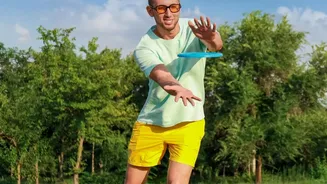
At its core, playing with a frisbee is an exercise in visuospatial skill, which is the brain's ability to understand, analyze, and manipulate objects and their relationships in two and three dimensions. This isn't just about seeing; it's about processing.
Every time you throw or catch a disc, your brain is performing a complex series of calculations. You're judging distance, speed, and trajectory, all while accounting for external factors like wind. This mental workout is crucial for everything from navigating a crowded street to parking a car. Activities that challenge these skills are vital for cognitive health, and a game of frisbee is a uniquely effective and accessible option.
The Science of the Throw and Catch
The magic of frisbee play lies in its dynamic nature. Unlike a simple ball, a frisbee’s flight path is complex. It floats, curves, and dips, forcing your brain to constantly update its predictions. This is an advanced form of object tracking. When you release a disc, you're not just throwing it at someone; you're throwing it to a space where they will be. The receiver, in turn, isn't just watching the disc; they are calculating its future position to intercept it. This continuous process of prediction, tracking, and interception enhances cognitive functions like problem-solving and concentration. It trains the brain to think ahead and mentally simulate future events, a skill that translates into better decision-making in countless real-world scenarios.
Building a Better Mind-Body Connection
Beyond visual processing, frisbee play is a fantastic tool for developing proprioception—often called our 'sixth sense.' This is your body's awareness of its own position and movement in space. To catch a soaring disc, you have to know where your hands, feet, and torso are without looking. You might have to leap, pivot, or sprint, making micro-adjustments on the fly. This develops hand-eye coordination and overall body control. For children, this is fundamental for developing motor skills. For adults, maintaining strong proprioception is key to good balance, coordination, and reducing the risk of falls and injuries later in life.
Benefits Beyond the Field
The skills honed during a casual game of frisbee have surprisingly broad applications. The constant running and sprinting provide a great full-body cardiovascular workout, improving heart health and stamina. Furthermore, the strategic thinking involved, especially in a team game like Ultimate Frisbee, sharpens mental agility and promotes teamwork. Players learn to read the field, anticipate the movements of others, and communicate effectively to create opportunities. Studies have also shown that regular physical activity and social engagement are linked to better mental wellness and may even help reduce the risk of cognitive decline. A game of frisbee delivers both physical exertion and social interaction, making it a holistic boost for your well-being.