








An 'Aerodynamics First' Philosophy
In the world of high-performance cars, a giant wing can often be dismissed as a cosmetic addition designed to look fast while parked. For the Toyota GR GT, however, nothing could be further from the truth. The entire vehicle was developed under an "aerodynamics
first" concept. This means that before a single line was sketched for style, aerodynamics engineers dictated the car's shape to optimize airflow. The entire design process was reversed from the norm; function dictated form, ensuring that every surface, including the prominent rear wing, serves a critical performance purpose. The goal was to create a road-legal race car, and that required a fanatical devotion to how the car interacts with the air at speeds over 320 km/h.
The Science of Downforce
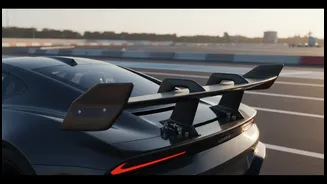
So, what does the wing actually do? Its primary function is to generate downforce. Think of it as an airplane wing, but flipped upside down. Instead of creating lift to make a plane fly, the wing creates a downward pressure that pushes the car onto the road. This is crucial at high speeds, as it significantly increases the grip of the rear tires. More grip translates into greater stability, especially during high-speed cornering and braking. Without this downforce, a car can feel light and unstable as air moving at speed tries to lift it. The GR GT's wing is engineered to counteract this lift, keeping the car planted and allowing the driver to confidently exploit its 641-horsepower hybrid V8 engine.
The Swan Neck Advantage
A closer look at the GR GT's wing reveals another layer of engineering sophistication: the 'swan neck' mounts. Traditionally, wings are mounted with supports from underneath. However, the GR GT's wing is attached from above. This is a deliberate choice borrowed directly from top-tier motorsports. The underside of the wing is the most critical surface for generating downforce, as this is where the air needs to flow quickly and smoothly. By mounting the wing from the top, the supports do not disturb the crucial airflow on the high-pressure underside. This results in cleaner, more efficient downforce generation with less drag compared to a conventional bottom-mounted wing. It's a small detail that makes a significant aerodynamic difference.
A Motorsport-Bred Total Package
It is important to remember that the wing does not work in isolation. It is the most visible part of a comprehensive aerodynamic package that starts at the front splitter, flows over the carefully sculpted body, and ends at the rear diffuser. The GR GT was developed as a cohesive unit by TOYOTA GAZOO Racing, the brand's motorsport division. Engineers and professional racing drivers worked together to ensure the car was balanced. The downforce at the rear from the wing must be balanced by aerodynamic elements at the front to prevent instability. The development of the road-going GR GT and its GT3 race car counterpart happened in unison, ensuring the lessons learned on the track were directly applied to the car you can actually buy.