






A Lonely Traveller's Next Destination
Many remember New Horizons for its stunning flyby of Pluto in 2015, which transformed our view of the distant dwarf planet. Four years later, it studied Arrokoth, the most remote object ever explored up close. But its journey was far from over. Today,
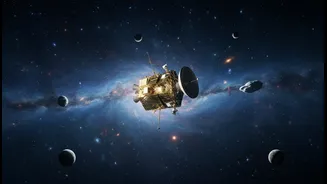
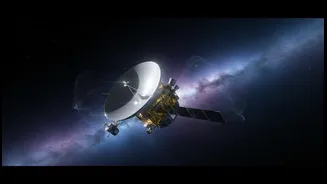
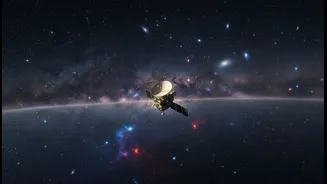
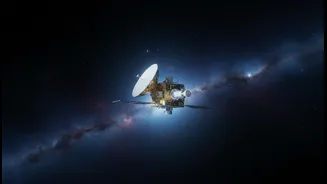
the spacecraft is over 9.5 billion kilometres from Earth, serving as a deep-space observatory in the Kuiper Belt, a vast ring of icy bodies beyond Neptune. It recently woke from a 321-day hibernation on June 23, 2026, in perfect health and ready for its next assignment: to study the very edge of our solar system. Its new target isn't an object, but a place: the termination shock.
What is the Termination Shock?
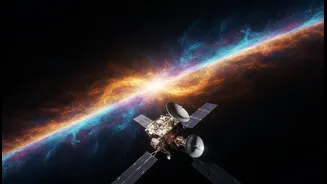
Imagine the Sun blowing a giant bubble in space. This bubble, called the heliosphere, is formed by the solar wind—a constant stream of charged particles flowing from the Sun at incredible speeds. This bubble shields our solar system from a significant amount of harsh galactic cosmic radiation. But far from the Sun, beyond the orbit of Neptune, this solar wind starts to slow down as it pushes against the gas and dust of interstellar space. The termination shock is the boundary where the solar wind's speed abruptly drops from supersonic to subsonic. Think of it like water from a tap hitting a sink; it spreads out quickly until it forms a distinct ring where the flow slows down. This boundary is the first major milestone on the journey out of our solar system and into interstellar space.
An Earlier Than Expected Arrival
The headline's claim comes from new research trying to predict when New Horizons will reach this crucial boundary. Scientists now estimate the probe could cross the termination shock as early as 2029. This is significant because the heliosphere isn't static; it expands and contracts based on the Sun's 11-year activity cycle. During periods of high solar activity, the heliosphere inflates, pushing the termination shock further out. During quiet periods, it shrinks. By modeling these cycles, researchers have created a window for when New Horizons might make the crossing. The earliest predictions place the encounter right at the end of this decade, which is sooner than many previous, broader estimates had suggested.
A Race Against a Fading Power Source
Reaching the shock sooner rather than later is critical. The phrase "before many expected missions end" refers to the operational lifespan of New Horizons itself. The spacecraft is powered by a Radioisotope Thermoelectric Generator (RTG), which uses the heat from decaying plutonium to generate electricity. This power source steadily weakens over time. While the probe has enough power to operate for another couple of decades in some capacity, its ability to run all its scientific instruments and transmit large amounts of data will diminish. Some estimates suggest the spacecraft will struggle to power even its basic systems by the mid-2030s. Therefore, crossing the termination shock while its key instruments are still fully functional is a primary goal for the mission's extended phase.
Learning from the Pioneers
Only two other spacecraft, Voyager 1 and Voyager 2, have ever crossed the termination shock, doing so in 2004 and 2007, respectively. They revealed that this boundary is complex and dynamic. Voyager 1 crossed at a distance of 94 astronomical units (AU) from the Sun, while Voyager 2 crossed at 84 AU, showing how much the heliosphere's shape can vary. Voyager 2 even crossed the boundary multiple times as it fluctuated back and forth. New Horizons provides a third, unique data point. It is traveling in a different direction and at a different time in the solar cycle, offering a chance to build a more complete, 3D understanding of our solar system's protective shield and how it interacts with the galaxy beyond.