



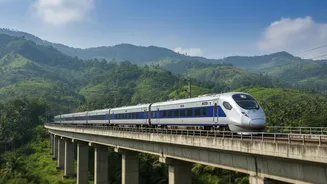


The Mountain Challenge
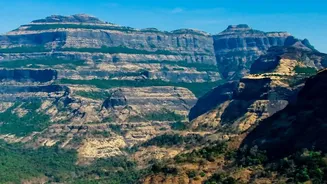
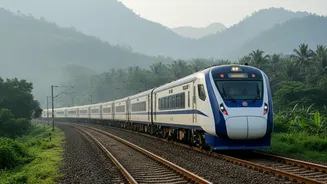
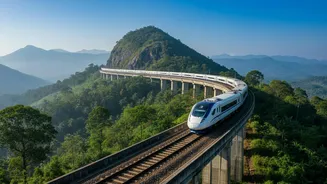
Indian Railways has commenced crucial trials for the Vande Bharat Express on the formidable Sakleshpur-Subrahmanya Road ghat section in Karnataka. This 55-kilometre stretch, part of the proposed Bengaluru-Mangaluru route, is one of the most technically
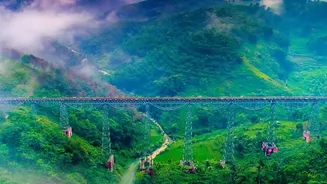
demanding railway corridors in the country. It snakes through the Western Ghats, featuring a steep gradient of 1-in-50, navigating through 57 tunnels and crossing 226 bridges, all while tackling 108 sharp curves. Historically, the terrain's difficulty has required conventional trains to use additional 'banker' locomotives to push them up the steep inclines, a time-consuming process. The current trials, running from August 11 to August 20, are designed to test if the Vande Bharat can conquer this route on its own power, a key step in expanding its network across India’s diverse geography.
A Specially Modified Train
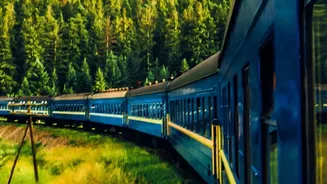
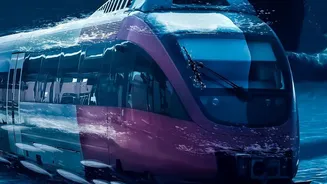
This isn't just any Vande Bharat train. A special 20-coach rake, manufactured by the Integral Coach Factory (ICF) in Chennai, has been assigned for these tests. The most critical modification is the inclusion of an Automatic Emergency Braking (AEB) system. This advanced safety feature is mandatory for operating on this specific ghat section and is designed to automatically apply the brakes if the train exceeds the restricted speed of 30 kilometres per hour on the steep downward slopes. The development of an AEB-equipped rake was a crucial prerequisite for these trials, as previous assessments had raised concerns about the suitability of standard Vande Bharat trains for such a demanding environment. The self-propelled design of the Vande Bharat, which distributes power across its coaches, makes attaching traditional banker locomotives impractical, necessitating this bespoke technological solution.
What's Being Tested?
The trials are being meticulously overseen by the Research Designs and Standards Organisation (RDSO), Indian Railways' R&D wing. Teams from multiple departments are on board to monitor a wide array of parameters. This goes far beyond simply checking if the train can move from one point to another. Engineers are closely evaluating the performance of the braking systems, particularly the new AEB, along with acceleration and deceleration patterns on the steep gradients. They are also assessing the train's stability while navigating sharp curves and the overall handling characteristics. The data collected will determine the train's operational feasibility, safety, and efficiency on this challenging terrain, which is also prone to landslides during heavy monsoon rains.
Why This Trial Is a Landmark Moment
A successful trial on the Sakleshpur-Subrahmanya section would be a landmark achievement for Indian Railways. It would prove the Vande Bharat platform's capability to operate without banker engines on some of the nation's steepest and most complex railway lines, like the Thull and Bhor ghats near Mumbai. This would not only save operational time but also open up numerous other challenging routes for the expansion of semi-high-speed services. For the proposed Bengaluru-Mangaluru route, it is the final technical hurdle. The entire line was fully electrified in December 2025, a project that took nearly two years to complete through the difficult ghats. If the trials are successful and all safety clearances are obtained, it will pave the way for a new era of faster, more comfortable travel between Karnataka's capital and its coastal hub.