

A Star's Fiery Goodbye
First, let's clear up a common misconception: despite the name, a 'planetary nebula' has nothing to do with planets. The term is a historical holdover from when early astronomers thought these glowing, round objects resembled planets through their telescopes.
In reality, they are the magnificent final act of a Sun-like star. When a star of this size runs out of its primary fuel, it sheds its outer layers of gas into space. The object in question, known officially as NGC 2392, is a prime example of this cosmic event. While it has previously been called the Clown-Faced Nebula or Eskimo Nebula, this new Webb image has popularized the name 'Lion Nebula' because the intricate halo of gas and dust strikingly resembles a lion's majestic mane.
Webb's Unprecedented View
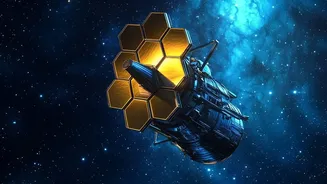
The James Webb Space Telescope (JWST) sees the universe in infrared light, which gives it a powerful advantage over telescopes that primarily use visible light, like the Hubble Space Telescope. While Hubble provided spectacular images of NGC 2392 in the past, Webb’s vision pierces through obscuring layers of cosmic dust. This allows it to capture the fainter, more complex structures with astonishing clarity. The new composite image, combining data from Webb's Near-Infrared Camera (NIRCam) and Mid-Infrared Instrument (MIRI), reveals the 'sculpted' gas in a way that was previously impossible. It brings hidden details of the nebula’s shells and filaments into sharp focus, transforming our understanding of this celestial lion.
The 'Sculpted Gas' in Detail
The portrait reveals that the Lion Nebula is not one uniform cloud, but a complex, multi-layered structure. At its heart is the intensely hot remnant of the star, a white dwarf, which looks like the lion's nose. This stellar core is blasting out radiation and powerful stellar winds, 'cooking' the surrounding gas and carving out a bubble. This forms the lion's 'face.' The outer region, or the 'mane', is an older, more spread-out shell of dust and gas that the star ejected earlier in its death throes. Webb’s image clearly distinguishes these different layers and shows how the faster, inner winds are catching up to and interacting with the slower, older material, creating the intricate and turbulent patterns we see.
Cosmic Clues in the Mane
The most fascinating details lie within the lion’s mane. The image reveals numerous dense clumps of dust and gas with long, flowing tails pointing away from the central star. These 'cometary knots' are sculpted by the fierce stellar radiation. The dense heads of these clumps have managed to survive the onslaught, protecting the material behind them and creating the beautiful, streaking tails. By studying the shape, size, and orientation of these features, astronomers can act like cosmic forensic scientists. They can piece together the history of the star’s mass loss, confirming that it wasn't a single, smooth event but a series of dynamic and violent ejections.
A Glimpse of Our Sun's Distant Future
Observing the Lion Nebula isn’t just about studying a distant, beautiful object; it’s also a preview of our own solar system’s ultimate destiny. The star at the center of NGC 2392 was once much like our Sun. In approximately five billion years, our Sun will also exhaust its nuclear fuel, expand into a red giant, and cast off its outer layers, forming its very own planetary nebula. Studying the Lion Nebula in such exquisite detail gives us a valuable glimpse into the complex and beautiful processes that will one day unfold in our own cosmic neighborhood. Each new image is a piece of the puzzle, helping us understand the life cycle of stars across the universe.