






Two Windows to the Moon
To study the Moon, scientists have two primary sources of physical material. The first is through robotic or crewed missions that bring back samples, like the historic Apollo missions and, more recently, India’s Chandrayaan-3. These samples are pristine
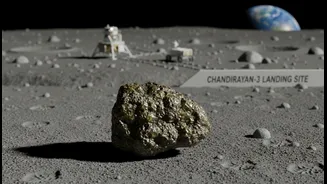
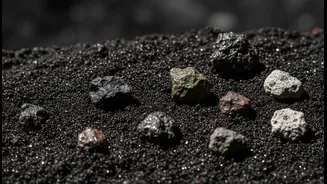
and their exact origin is known, making them incredibly valuable. Chandrayaan-3 provided the first-ever on-site analysis of soil from the lunar south pole’s highlands. The second source is lunar meteorites—pieces of the Moon that were blasted into space by asteroid impacts and eventually fell to Earth. These cosmic messengers are crucial because they provide samples from random locations all over the Moon, but their exact home on the lunar surface is unknown. For decades, scientists have relied on these meteorites, hoping they represent the Moon's broader geology.
The Ground Truth from Pragyan
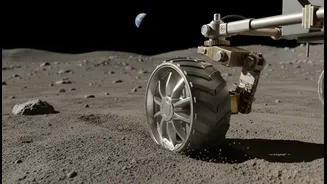
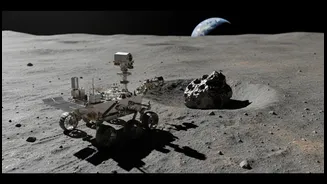
After its historic landing on August 23, 2023, the Pragyan rover from the Chandrayaan-3 mission got to work. Onboard was the Alpha Particle X-ray Spectrometer (APXS), an instrument developed by PRL in Ahmedabad. The rover traversed over 100 metres around its landing site, named Shiv Shakti Statio, taking measurements of the elemental composition of the lunar soil. The data revealed that the soil at this south polar site was different from typical lunar highlands. It had lower levels of aluminium but was richer in iron and magnesium. This suggested the soil was not just surface material, but a mixture that included rocks from deeper within the Moon's crust.
A Match Found in Antarctica
The PRL scientists embarked on a major comparison. They took the APXS data from Shiv Shakti Statio and compared it against the known chemical compositions of 66 feldspathic lunar meteorites found on Earth. Out of all of them, one stood out: a meteorite designated ALHA 81005. This specific rock holds a special place in history; discovered in Antarctica’s Allan Hills region during an expedition in 1981-82, it was the very first meteorite to be officially confirmed as originating from the Moon. The geochemical makeup of this four-decade-old meteorite was found to be the closest match to the soil analysed by Chandrayaan-3.
What the Similarity Means
The chemical resemblance is striking. For example, the soil at Shiv Shakti Statio has an aluminium oxide content of about 26.1%, while ALHA 81005 has 25.8%. The combined iron and magnesium oxide content is also very close, at 14.4% for the Chandrayaan-3 site and 13.7% for the meteorite. Both samples occupy a rare compositional space between the two main types of lunar crustal rocks. However, ISRO and PRL scientists are careful to clarify that this does not mean the meteorite was blasted off from the exact spot where Chandrayaan-3 landed. Instead, it indicates that both the landing site and the meteorite represent a similar, specific type of magnesium-rich crust that may be widespread in the lunar highlands.
Validating Decades of Research
This discovery is significant for several reasons. Firstly, it provides 'ground truth' for meteorite studies. For years, scientists have analysed lunar meteorites with the assumption that they are representative samples. By finding a direct link between a mission-analysed site and a specific meteorite, this study validates the use of these rocks to understand the Moon. Secondly, it highlights the complex geology of the lunar south pole. The soil composition, rich in deeper crustal materials, supports the theory that a massive ancient impact—the one that created the South Pole-Aitken basin—excavated material from deep within the Moon and scattered it across the surface. This gives scientists clues about the Moon’s early evolution and the 'Lunar Magma Ocean' hypothesis, which suggests the Moon was once covered in molten rock.