






An Ocean World in Deep Space
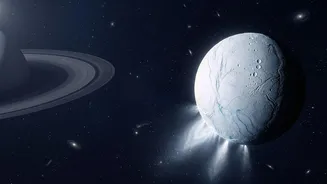
Enceladus might look like a simple snowball in space, but it holds a spectacular secret. Beneath its bright white, frozen shell lies a global ocean of liquid saltwater. We know this thanks to NASA's Cassini spacecraft, which flew past the moon multiple
times and made a stunning discovery: gigantic plumes of water vapor and ice particles erupting from deep cracks in the moon's southern polar region. These geysers, like cosmic fire hoses, spray material from the hidden ocean hundreds of kilometers into space, offering scientists a direct sample of an alien sea. Analysis of these plume particles revealed that the ocean is salty and contains a fascinating mix of organic compounds, the carbon-based molecules that are fundamental to life as we know it.
Simulating an Alien Sea on Earth
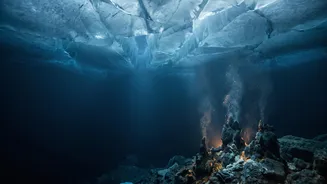
While Cassini provided a wealth of data, some questions remained. To get a better handle on the ocean's true chemistry and its potential to support living organisms, scientists turned to an ingenious approach: recreating the conditions of Enceladus in a lab. Recent studies have done just that, mixing water, salts, carbonates, and powdered rock to mimic the high-pressure, low-oxygen, and highly alkaline environment believed to exist at the bottom of Enceladus's ocean. In one remarkable experiment, researchers introduced a type of Earth microbe, Methanothermococcus okinawensis, which thrives near deep-sea hydrothermal vents, into this simulated alien sea. To their astonishment, the microbe not only survived but grew and reproduced, proving that at least some forms of terrestrial life could find Enceladus's ocean quite comfortable.
The Phosphorus Breakthrough
Life on Earth requires six key elements: carbon, hydrogen, nitrogen, oxygen, phosphorus, and sulfur (CHNOPS). Cassini's data had hinted at the first five, but phosphorus, a critical component of DNA and cell membranes, remained elusive, leading some to question the moon's habitability. This is where other lab simulations have provided a breakthrough. By modeling the geochemistry of Enceladus's rocky seafloor interacting with its ocean, scientists predicted that phosphate—a form of phosphorus—should be surprisingly abundant, dissolving into the water at levels close to or even higher than in Earth's oceans. This finding powerfully suggests that all the essential ingredients for life are likely present on Enceladus.
Nature's Surprising Sorting Hat
Another recent study, also based on lab work and re-analysis of Cassini data, revealed another gift from Enceladus. Scientists had been puzzled why different ice grains collected by the spacecraft had such varied chemical compositions. The lab experiments showed that as the ocean water freezes slowly on its journey up through the ice cracks, different salts and organic compounds separate from each other and become concentrated in individual ice fragments. This is fantastic news for future missions, as planetary scientist Frank Postberg noted. It means Enceladus naturally sorts and concentrates its chemical clues, making it potentially much easier for a future probe to detect key compounds, including any potential signs of life, without needing to process vast quantities of material.