





Beyond Landing: The New Frontier of Reusability
For years, SpaceX has wowed the world by landing the first stages of its Falcon 9 rockets on drone ships and landing pads. But for its next-generation Starship system, landing is not enough. The ultimate goal is 'full and rapid reusability'—a paradigm
where a rocket can be launched, recovered, and launched again in hours, much like a commercial airliner. This requires eliminating time-consuming recovery and refurbishment processes. Instead of landing on legs at sea or on a distant pad, SpaceX’s plan is to have the rocket fly directly back to its launch tower and be caught by a giant set of mechanical arms. This manoeuvre, central to the objectives of test missions like Flight 15, is the critical next step in drastically reducing the cost of accessing space.
Meet 'Mechazilla': The Tower That Catches Rockets
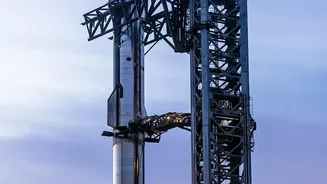
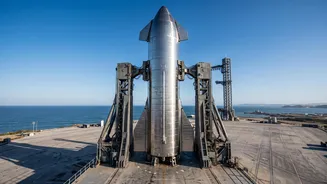
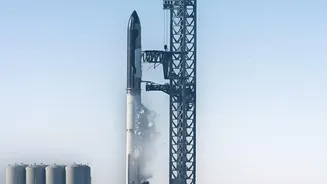
The key piece of hardware for this feat is the launch and integration tower, nicknamed 'Mechazilla' by CEO Elon Musk. Standing over 400 feet tall, this steel structure is not just a platform for launching rockets; it’s an active participant in their recovery. Its most prominent features are two colossal arms, often called the 'chopsticks', that can move up and down the tower. These arms are strong enough to lift the massive Super Heavy booster and the Starship spacecraft onto the launch mount before a flight. Their even more ambitious job is to do the reverse: catch the returning stages in mid-air just moments before they would otherwise touch down. This dual-purpose design is a radical departure from any launch infrastructure ever built.
The Catch Sequence: A High-Stakes Robotic Ballet
The catch sequence is an exercise in extreme precision. For the Super Heavy booster, the process begins minutes after stage separation. The booster reorients itself, performs a 'boostback' burn to reverse its course, and targets the launch site. As it descends, it uses its grid fins for steering and fires its Raptor engines to slow down, aiming to arrive at the tower with near-zero velocity. The Mechazilla arms open wide, and using GPS and radar data, track the booster’s final approach. At the last second, the arms clamp shut on reinforced hardpoints on the booster, arresting its motion. The system uses shock absorbers to dampen the immense forces. For Starship Flight 15, which launched on November 13, 2026, this procedure was attempted for both the booster and, for the first time ever, the Starship upper stage after it completed its orbital mission.
Why Risk It? The Economics of the Catch
The primary driver for attempting such a risky manoeuvre is economics. By catching the booster and ship, SpaceX can eliminate the need for heavy and complex landing legs. Removing this mass directly translates into the ability to carry more payload into orbit. Furthermore, catching the hardware directly at the launch pad eliminates the entire process of retrieving a stage from a landing zone or the ocean, which can take days. It removes the need for cranes, transport vehicles, and extensive ground support equipment. The goal is to catch, refuel, and restack the vehicle for its next mission in the shortest time possible. This rapid turnaround is essential for SpaceX's long-term plans, including deploying its massive Starlink satellite constellation and eventually building a self-sustaining city on Mars.
Flight 15: A Partial Success, A Giant Leap
Starship Flight 15 aimed to be the first mission to recover both stages via a tower catch. While the Super Heavy booster's catch was aborted due to it being low on fuel, diverting it to a splashdown in the Gulf of Mexico, the mission achieved a historic milestone. After orbiting the Earth for over 22 hours and deploying 26 Starlink satellites, the Ship 42 upper stage successfully re-entered the atmosphere, navigated back to Starbase, and was caught by the Mechazilla arms on November 14, 2026. This was the first time in history an orbital-class spacecraft was recovered this way, a moment hailed as the 'holy grail of spaceflight'. It proved that the harder half of the reusability equation—recovering the stage that endures the heat of orbital reentry—is achievable.