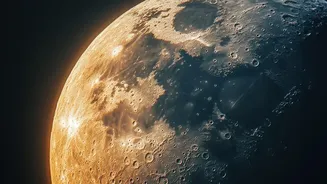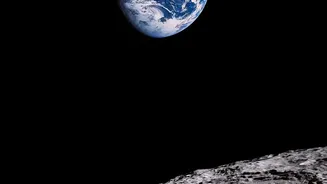




Look up at the night sky, and you’ll see a familiar sight: the 'man in the moon'. But have you ever stopped to wonder why those same craters and seas are always facing us, night after night, year after year? It's no coincidence.
A Perfectly Synchronized Dance
The phenomenon behind this
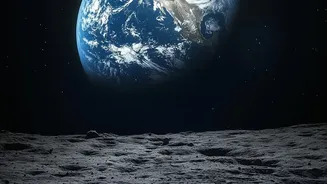
constant lunar gaze is called 'synchronous rotation' or 'tidal locking'. It might sound complex, but the idea is simple. The Moon rotates on its own axis at the exact same rate that it revolves around the Earth. It takes our celestial neighbour about 27.3 days to complete one full spin, and it takes the same amount of time to complete one full orbit around us. To visualize this, imagine a dancer circling a partner while always keeping their face pointed toward them. To do this, the dancer must slowly spin around once for every full circle they make. If the Moon didn't rotate at all, we would see its entire surface as it orbited Earth. But because its rotation and orbit are perfectly synchronized, we are locked in this perpetual stare-down.
Gravity's Unseen Influence
So, how did this perfect timing come to be? The answer is gravity, and the tides it creates not in water, but in solid rock. Billions of years ago, when the Moon was newly formed and much closer to Earth, it spun much more rapidly. Earth’s immense gravitational pull exerted an uneven force on the Moon, tugging more strongly on the side closer to us than on the far side. This differential pull stretched the young, molten Moon into a slight oblong, or football, shape. As the fast-spinning Moon tried to rotate this bulge away, Earth’s gravity constantly tried to pull it back into alignment. This constant tug-of-war created immense friction inside the Moon, converting rotational energy into heat. This process acted like a brake, gradually slowing the Moon’s spin over millions of years until it settled into the most stable configuration: a captured rotation where the bulge always points toward Earth.
Myth-Busting the 'Dark Side'
This leads to one of the most common cosmic misconceptions: the 'dark side' of the Moon. The side we don't see is more accurately called the 'far side'. It's not permanently dark. In fact, both the near and far sides of the Moon experience roughly two weeks of daylight followed by two weeks of night, just like Earth has day and night. The 'dark side' is simply whichever hemisphere is not being illuminated by the Sun at any given moment. During a 'new moon' phase, when the side facing us is dark, the far side is fully lit by the sun. Conversely, during a 'full moon', the far side is experiencing its night. The term 'dark' originally meant 'unseen' or 'unknown' because, until the Soviet Luna 3 probe photographed it in 1959, humanity had never laid eyes on it.
A Common Cosmic Connection
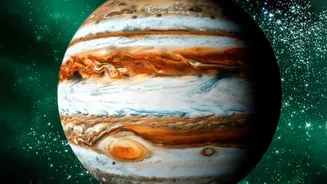
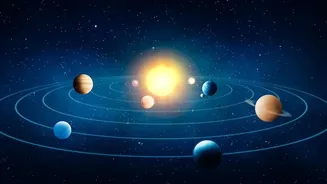
While it might seem like a unique quirk of our Moon, tidal locking is actually a common phenomenon throughout the solar system and beyond. Most of the major moons orbiting Jupiter and Saturn are also tidally locked to their giant parent planets. Even the dwarf planet Pluto and its largest moon, Charon, are mutually tidally locked, meaning they both keep the same face pointed toward each other as they orbit a common center of mass. This gravitational dance is an inevitable outcome when two bodies orbit each other closely for a long enough time. It’s a powerful reminder of the fundamental forces that shape the cosmos, turning what looks like a cosmic coincidence into a predictable and fascinating feature of celestial mechanics.