




A Strategic Alliance for the Stars
NASA and the Department of Energy (DOE) have a long history of collaboration, but their renewed partnership is focused on one of the biggest challenges in space exploration: energy. In October 2026, the two agencies signed a new Memorandum of Understanding
to accelerate the development of space nuclear technologies. This formal agreement unites NASA’s expertise in space missions with the DOE's deep knowledge of nuclear science, reactor development, and fuel production. The goal is to create safe and reliable nuclear systems that can power everything from lunar bases to the rockets that will carry humans to Mars. This collaboration is a cornerstone of the Artemis program, which aims to build a sustainable presence on the Moon as a stepping stone for future deep-space missions.
Powering a Home on the Moon
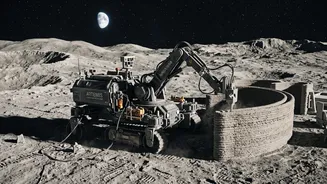
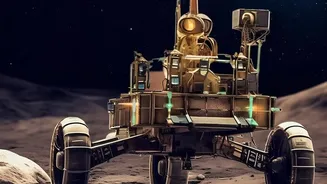
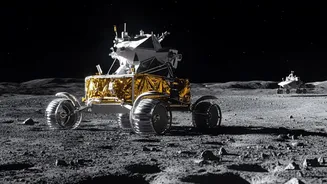
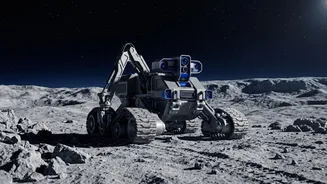
One of the partnership's primary goals is the Fission Surface Power (FSP) project. The challenge with lunar exploration is that a single night lasts for about 14 Earth days, making solar power an unreliable primary energy source. A small nuclear fission reactor could provide continuous, dependable power regardless of sunlight. NASA and the DOE are working with commercial partners to develop a 40-kilowatt class fission power system, enough to power about 30 households for at least ten years. The plan is to have a demonstration reactor ready for the Moon by the early 2030s. This 'Lunar Reactor-1' would energize habitats, rovers, scientific experiments, and resource utilization plants, making a long-term human settlement possible.
The Nuclear Express to Mars
Getting to Mars with current chemical rocket technology would take six to nine months. This long journey exposes astronauts to prolonged risks from cosmic radiation and zero gravity. To solve this, the partnership is heavily invested in Nuclear Thermal Propulsion (NTP). In an NTP system, a nuclear reactor heats a propellant like liquid hydrogen to extreme temperatures and expels it through a nozzle to create thrust. This method is roughly twice as efficient as the best chemical rockets, which could slash the travel time to Mars significantly. Shorter transit times not only enhance crew safety but also allow for more flexible mission plans, including faster abort-to-Earth scenarios if needed.
Why Nuclear is a Game-Changer
For decades, space missions have relied on chemical rockets for launch and solar panels or radioisotope systems for onboard power. While effective, these technologies have limitations. Chemical rockets are inefficient for long voyages, and solar panels become progressively weaker as a spacecraft travels farther from the sun. Nuclear fission offers a leap in both power density and reliability. A nuclear-powered spacecraft requires far less propellant than a chemical one, freeing up mass for more scientific instruments and supplies. Furthermore, nuclear systems can provide the robust, continuous power needed for ambitious activities like mining resources on the Moon or running complex life-support systems on Mars, heralding what NASA has called a 'Nuclear NASA-era'.
An Uncompromising Stance on Safety
The prospect of launching nuclear reactors into space naturally raises questions about safety. The NASA-DOE partnership places safety at the forefront of all its development efforts. The reactors are designed to remain inactive until the spacecraft has safely reached a stable orbit or its deep-space trajectory, minimizing risks during launch. For instance, the planned Space Reactor-1 Freedom mission will only start up its reactor 48 hours after launch, once it has escaped Earth's gravity. The systems undergo rigorous testing and are designed to be resilient in the harsh environment of space. This collaboration combines decades of experience from both civilian space flight and nuclear energy management to ensure these powerful technologies are deployed responsibly.