




The Ocean's Hidden Symphony
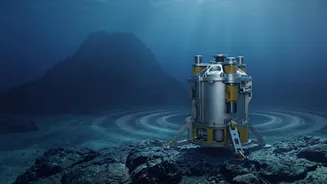
Sound travels remarkably well in water—far more efficiently than it does through air. This principle has long been used by marine mammals to communicate across vast distances. Scientists employ a similar concept using underwater microphones called hydrophones.
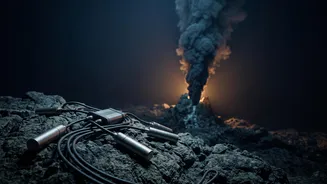
These sensitive devices are moored deep in the ocean, forming a global network that constantly listens. Originally designed for purposes like monitoring nuclear tests or tracking submarines, this network can detect a wide range of acoustic events. By tuning into the right frequencies, researchers can pick up the sounds of distant earthquakes, submarine landslides, and, most importantly, the activity of underwater volcanoes. These hydrophone arrays act as our ears in the deep, giving us insight into geological events that are otherwise invisible.
A Volcano's Acoustic Fingerprint
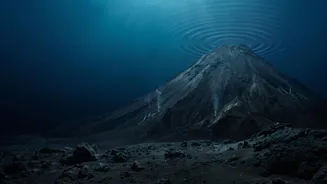
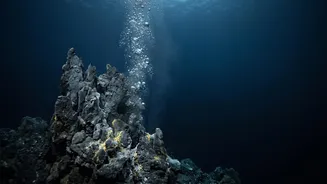
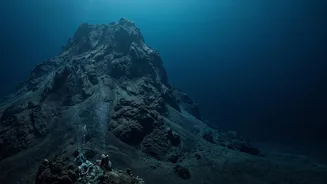
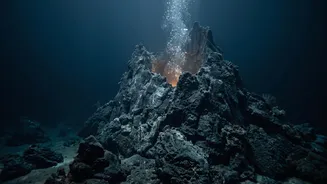
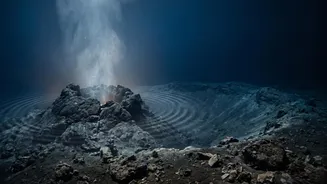
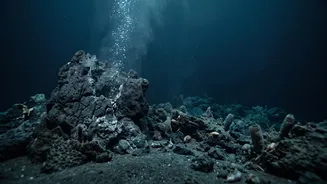
Just like events on land, geological processes underwater create distinct sounds. A submarine volcano isn't silent; it produces a whole suite of acoustic signals. These can range from the low rumble of magma moving beneath the seafloor to the sharp crackle of hot lava interacting with cold seawater. Most critically, major events like a powerful eruption or the collapse of a volcanic flank generate powerful, low-frequency sound waves known as T-waves. These signals are so strong they can travel thousands of kilometres through the ocean's 'SOFAR' channel, a layer in the water column that acts as a highly efficient sound conduit. The 2022 eruption of the Hunga Tonga-Hunga Ha'apai volcano provided a dramatic case study. Its catastrophic caldera collapse produced an enormous acoustic signal that was detected at monitoring stations across the Pacific, providing a clear acoustic fingerprint of the event.
From Eruption to Ocean-Wide Threat
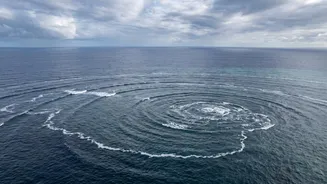
Not all volcanic eruptions create tsunamis, but certain events are highly effective at displacing massive volumes of water. The most dangerous are not always the initial explosions. In the case of Hunga Tonga, research has shown that the largest and most destructive local tsunami was not caused by the initial blast, but by the subsequent collapse of the volcano's caldera. This sudden, large-scale displacement of the seafloor acts like a giant paddle, pushing the water outwards and generating a devastating wave. Before this research, it was difficult to identify the specific mechanism behind volcanic tsunamis in real time. Conventional seismic monitors, often located far away on land, can struggle to distinguish the signals of a collapse from other eruption-related tremors.
Listening for a Faster Warning
Herein lies the crucial advantage of acoustic monitoring. Sound travels through water at about 1.5 kilometres per second. A tsunami wave, by contrast, travels much more slowly across the open ocean. This speed difference creates a critical window of opportunity. The acoustic signal—the T-wave from a volcanic collapse—will reach distant hydrophones long before the tsunami wave itself makes landfall. Traditional tsunami detection systems, like DART buoys, rely on a pressure sensor on the seafloor to detect the tsunami wave as it passes over. This is effective but confirms the tsunami is already in motion. By detecting the acoustic signature of the cause of the tsunami (the collapse), scientists can issue a warning faster, potentially adding crucial minutes or even hours to evacuation times for at-risk coastal areas.
The Future of Tsunami Detection
This research is rapidly moving from theory to practice. Scientists are developing systems, like the Global Real-time Early Assessment of Tsunamis (GREAT) project, to automatically analyze hydroacoustic data and assess tsunami risks. This technology can complement existing warning infrastructures, providing an independent and faster method of validation, especially for non-earthquake sources like volcanoes and landslides which traditional systems struggle with. While challenges remain, such as expanding the global network of real-time hydrophones, the 2022 Hunga Tonga event proved the concept's immense potential. For countries with extensive coastlines like India, which relies on the Indian Ocean Tsunami Warning System, integrating this acoustic data layer could significantly enhance public safety and provide more robust protection against these unpredictable natural disasters.