







A Fortunate Mistake
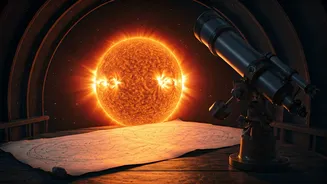
On May 28, 1607, Johannes Kepler, one of history’s most brilliant astronomers, was eagerly awaiting a transit of Mercury across the sun. Lacking a telescope, which had not yet been turned to the heavens, he used a camera obscura—a darkened room with a pinhole
that projects an image of the outside world onto a surface. As sunlight streamed in, an image of the solar disc appeared on his paper. There, he saw a small black spot and, believing it to be the elusive planet, carefully sketched it. He had no idea he was documenting something far more common but, at the time, scientifically revolutionary: a sunspot. Had he been able to observe it the next day, he would have realized his error, as the spot would have remained, unlike the swift passage of a planet. His detailed notes and drawings, however, became a pivotal, if accidental, contribution to solar science.
A Sun With Blemishes?
Today, we know sunspots are common, temporary dark patches on the sun’s surface caused by intense magnetic activity. But in the early 17th century, this was a radical concept. The dominant view, inherited from the ancient Greek philosopher Aristotle, was that the celestial realm was perfect and immutable. The sun, as a heavenly body, was supposed to be a flawless orb. The idea that it could have temporary blemishes or spots was philosophically and theologically disruptive. For this reason, many earlier naked-eye sightings of large sunspots, particularly in Europe, were often dismissed or explained away as atmospheric phenomena or the transits of planets, just as Kepler initially did. This belief in celestial perfection created a powerful bias, preventing astronomers from seeing what was right in front of them.
The Telescope Changes Everything
Just a few years after Kepler’s camera obscura drawing, the newly invented telescope was pointed at the sun, kicking off a race to understand these mysterious blemishes. English astronomer Thomas Harriot was the first to telescopically observe sunspots in December 1610, creating nearly 200 drawings over the next two years. He was soon followed by a host of other observers across Europe. In early 1611, Johannes and David Fabricius in Holland and Christoph Scheiner in Germany made their own independent discoveries. The famed Italian astronomer Galileo Galilei also began his systematic observations around the same time, though his first publications on the matter came in 1612. The use of the telescope marked the true beginning of the scientific study of sunspots, moving from a single, mistaken observation to a subject of intense international debate and investigation.
What Are Those Spots?
The key scientific debate fell to two intellectual giants: Galileo Galilei and Christoph Scheiner. Scheiner, a Jesuit mathematician, argued that the spots could not be on the sun itself, as that would imply imperfection. He proposed they were small planets orbiting very close to the sun, which only appeared as dark spots when they passed in front of it. Galileo powerfully refuted this. Through meticulous observation, he showed that the spots changed shape as they moved across the solar disc, appearing to foreshorten near the edge, just as an object on a rotating sphere would. He also noted that they formed and dissolved on the sun's surface. This could only mean one thing: the spots were on or very near the sun's surface. Galileo’s logic was so convincing that it ultimately won the argument, cementing the fact that the sun was not a perfect, unchanging orb.
Gazing at the Sun for Millennia
While Kepler’s drawing is the oldest made with a scientific instrument, and the telescopic observations of 1610-1612 mark the start of modern solar astronomy, humanity had been noticing sunspots for thousands of years. The earliest known written record comes from China in the I Ching, before 800 BCE. Chinese imperial astronomers were regularly documenting sunspot sightings by 28 BCE, often viewing the sun at sunrise or sunset when its glare was diminished. The oldest surviving drawing of a sunspot comes not from a professional astronomer but from an English monk, John of Worcester, who sketched two large spots in December 1128. These records show that Kepler was part of a long tradition of observation, but his use of an instrument to project and trace the image represented a crucial step toward quantitative scientific analysis.