
Reading a Galaxy's Fossil Record
To understand the life story of a galaxy 2.5 million light-years away, astronomers can't just watch it happen in real-time. Instead, they become cosmic archaeologists, using powerful telescopes like Hubble to study the galaxy's 'fossil record'—its stars.
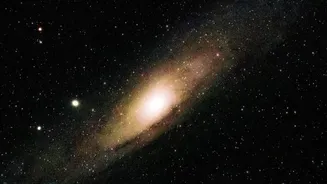
By creating a vast mosaic from hundreds of Hubble snapshots, scientists were able to resolve and analyse around 200 million individual stars across two-thirds of Andromeda's disk. This unprecedented detail allows them to determine the age of stellar populations. Massive, bright blue stars burn out quickly, indicating recent star birth, while smaller, redder stars live for billions of years, revealing the galaxy's older history. By mapping these different star populations, scientists can rewind time and reconstruct Andromeda's past activity.
A Tale of a Burst and a Bust
The story Hubble tells is one of a dramatic past followed by a long, steady decline. About two billion years ago, Andromeda experienced a massive burst of star formation, likely triggered by a merger with another, smaller galaxy. During this period, the galaxy was a furious stellar nursery. However, a new comprehensive study has revealed that for the last 500 million years, this activity has been winding down. The rate of new star creation 500 million years ago was about one solar mass per year, similar to our own Milky Way today. But that rate has plummeted; by 40 million years ago it had halved, and today it is down to just one-fifth of a solar mass per year. Andromeda is not running out of fuel, but rather seems to be taking a breather after its marathon of star-making.
Is a Meddling Neighbour to Blame?
While the overall decline seems to be a natural part of Andromeda's life cycle after its earlier starburst, the sharper, more recent drop has a prime suspect: the small satellite galaxy known as M32. Astronomers noticed that the decline in star formation was particularly pronounced in regions of Andromeda's disk closest to M32. The timing suggests an interaction around 60 million years ago could be responsible for disrupting gas clouds and slowing star birth in that area. While astronomers can't definitively say M32 is the culprit, its proximity makes it the most likely candidate for this localised slowdown. This interaction provides a fascinating glimpse into the complex gravitational dance that shapes how and where galaxies form their stars.
The Slow Fading of the Cosmic Lights
Andromeda's slowdown isn't unique. On a universal scale, the era of peak star formation is long behind us. The universe's star-making activity peaked around 10 billion years ago and has been declining ever since. Most galaxies, including our own, are past their prime. They are steadily converting their available gas into stars, but this raw material is a finite resource. Eventually, trillions of years from now, the gas will be exhausted, and the universe will enter a 'Degenerate Era', becoming a much darker, colder place dominated by stellar remnants like white dwarfs and black holes. The story of Andromeda is a preview of the eventual fate that awaits all galaxies as the universe continues to expand and cool. For now, however, there is one last burst of cosmic fireworks to look forward to.
A Future Collision and a Final Spark
The slowing of Andromeda holds a special interest for us because our two galaxies are on a collision course. In about 4.5 billion years, the Milky Way and Andromeda will merge. Far from being a destructive event, this galactic merger will likely trigger a massive new wave of star formation as the vast clouds of gas in both galaxies are compressed and ignited. This future 'Milkomeda' galaxy will experience a brilliant, final burst of star-making, using up much of the remaining fuel. It will be a spectacular, temporary revival before the combined galaxy settles into the same long, quiet decline that we now see beginning in Andromeda, joining the slow, graceful fading of the universe's lights.