




A Sudden Flash in the Dark
The story begins not with a steady gaze, but with a sudden burst of light in a place it wasn't expected. The Zwicky Transient Facility (ZTF), a robotic observatory that scans the entire night sky every two days, flagged an unusual flare. This wasn't just
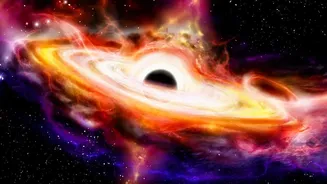
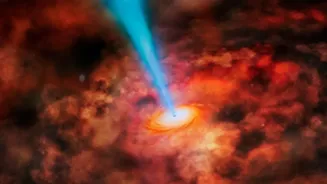
any flicker; it was a tidal disruption event (TDE), the tell-tale sign of a star being shredded by a black hole's immense gravity. Follow-up observations by NASA's Neil Gehrels Swift Observatory confirmed the event's extreme nature. But the real surprise was its location. The flare wasn't at the heart of its host galaxy, but tens of thousands of light-years out in the galactic suburbs, a staggering 30,000 light-years from the core. This immediately raised a critical question: what was a supermassive black hole doing out there?
An Exception to the Cosmic Rule
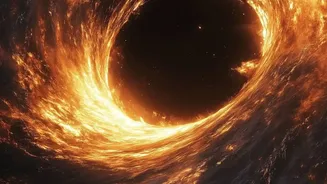
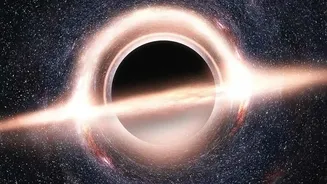
For decades, our model of the cosmos has been clear: virtually every large galaxy, including our own Milky Way, has a supermassive black hole anchored at its core. These gravitational behemoths, millions or billions of times the mass of our sun, are the anchors around which galaxies are built. Finding one so far from the centre is like finding the engine of a car bolted to the bumper. It defies the standard model of galactic architecture. This black hole was dormant and invisible until it consumed the passing star, which lit it up like a cosmic flare gun. This 'off-centre' black hole is so unusual because it suggests that our neat and tidy picture of galactic centres might be missing a major piece of the puzzle.
The Wandering Black Hole Theory
Scientists have long theorized about the existence of 'wandering' black holes. These aren't black holes that formed on their own in the void; they are believed to be the leftovers of cosmic collisions. When two galaxies merge, their central supermassive black holes eventually spiral towards each other and combine. However, the gravitational dynamics of these mergers are incredibly chaotic. One popular theory suggests that when a large galaxy consumes a smaller one, the smaller galaxy's central black hole can be stripped of its stars and flung into a wide, eccentric orbit within the new, larger galaxy. Another possibility involves a three-body interaction. If a galaxy already has two black holes and a third arrives via a merger, the complex gravitational dance can violently eject the smallest of the three from the galactic centre. These ejected black holes then roam the outskirts of their new home, silent and unseen.
Connecting the Discovery to the Theory
The discovery of this off-centre TDE is one of the strongest pieces of evidence yet to support the wandering black hole theory. It's a direct observation of a massive object existing far from a place where it could have easily formed. The black hole, estimated to be about one million times the mass of our Sun, revealed itself only because of the unlucky star that strayed too close. This chance event provided a brief, luminous billboard pointing directly to the wanderer's location. By finding this object not through its own light but through its destructive interaction with something else, astronomers validated a new technique for hunting these invisible giants. It turns the very silence of these objects into a tool for their discovery.
Rewriting Our Understanding of Galaxies
Finding one wandering black hole is significant, but scientists believe it's just the tip of the iceberg. This discovery has huge implications for how we understand the evolution of galaxies. The number of wandering black holes in a galaxy could act as a historical record, telling us how many mergers it has undergone over billions of years. Furthermore, these roaming black holes could be a source of previously unexplained gravitational waves. As they drift, they could eventually encounter other black holes, leading to mergers that ripple through spacetime. Until now, finding these wanderers was nearly impossible because they are dormant and emit no light. Now, using AI to scan for off-centre TDEs, astronomers expect they may find many more, turning a long-held theory into a new field of observational astronomy.