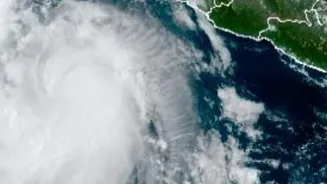








For millions living along India's vast coastline, the familiar dread of an approaching cyclone is a race against time. Now, artificial intelligence is rewriting the rules of that race, promising faster, more accurate forecasts.
The Challenge with Traditional Forecasting
For decades, predicting
a cyclone's path and, crucially, its intensity has been a monumental task. Traditional methods, known as numerical weather prediction (NWP), rely on solving complex physics equations. These models simulate the atmosphere using real-time data from satellites and aircraft on temperature, pressure, and wind. While these systems have improved immensely over the years, they are computationally expensive, requiring powerful supercomputers and hours to generate a single forecast. This time lag can be critical, especially when a storm is rapidly intensifying just before making landfall—a phenomenon that has historically been very difficult to predict. For disaster management teams and communities, every hour gained in warning time is vital for evacuations and preparedness.
How AI is Changing the Game
Instead of solving physics equations from scratch, AI models learn from the past. Trained on decades of historical weather data, these systems, often built on neural networks, learn to recognise complex patterns that precede major weather events. Models like Google's GraphCast, which became a focal point in 2023, analyse vast global datasets to predict the future state of the atmosphere. In India, the Meteorological Department (IMD) has adopted AI-assisted tools to improve cyclone tracking and intensity estimates. Researchers are also developing advanced neural networks to better predict monsoon behaviour and storm paths, with studies showing significant improvements in forecasting up to 96 hours before landfall.
The Twin Benefits: Speed and Accuracy
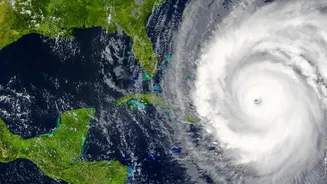
The most significant advantage of AI is speed. An AI model like GraphCast can generate a 10-day forecast in under a minute on specialised hardware, a task that takes hours for traditional systems. This speed allows for the rapid generation of many possible forecast scenarios, giving meteorologists a better understanding of the range of potential outcomes. This is transforming the field, with advancements that once took a decade now happening in the span of a year. In terms of accuracy, these new models are already proving their worth. AI systems have shown they can outperform even the best traditional models in predicting a storm's track. For example, during Hurricane Isaias in October 2026, a Google DeepMind AI model correctly predicted its landfall in the Florida Panhandle when conventional models pointed elsewhere.
A Tool, Not a Replacement
Despite their power, AI models are not infallible. Meteorologists point out that while AI is excellent at predicting a storm's path, it can sometimes struggle with forecasting its intensity, or wind strength. Furthermore, because AI models learn from historical data, they operate as a 'black box'—experts don't always know precisely why an AI model gets a forecast right or wrong. For this reason, human expertise remains irreplaceable. Forecasters at agencies like the National Hurricane Center in the U.S. and the IMD in India view AI as a powerful new tool in their arsenal. It complements traditional physics-based models, providing an independent and valuable second opinion that helps human experts make more confident and timely decisions.