




Reading the Fossil Record of a Galaxy
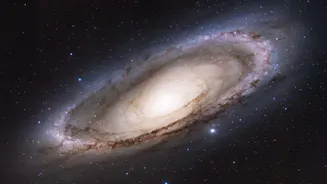
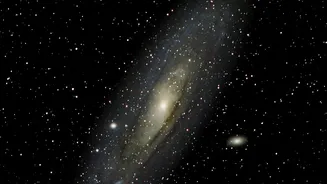
To understand the life story of a galaxy, astronomers look at its stars. A new study has done just that on an epic scale, analysing data from two massive Hubble surveys that mapped about two-thirds of Andromeda's disk. By studying around 200 million individual
stars, scientists have created the most detailed picture yet of Andromeda's recent history. They treat the stars as a 'fossil record'. Massive, young stars burn hot and appear blue, while older, less massive stars have a longer, redder life. By mapping the colours of its stars, scientists can see where and when star birth has been most active. The results showed that Andromeda's star-making prowess is fading.
A Slow and Steady Decline
The study revealed a dramatic slowdown. About 500 million years ago, Andromeda was creating stars at a healthy rate, converting about one Sun's worth of gas and dust into new stars each year. However, by 40 million years ago, that rate had already dropped by half. Today, the output has plummeted even further, to just one-fifth of a solar mass per year, marking its lowest known level of activity. This decline seems to be concentrated in a large, star-forming ring about 32,000 light-years from the galaxy's centre, where activity is fizzling out. Rather than suddenly running out of fuel, scientists believe the galaxy is simply taking a breather after a more energetic past. A massive burst of star formation about two billion years ago, likely caused by a merger with a smaller galaxy, set the stage for this long, quiet decline.
A Possible Galactic Accomplice
While the winding down appears natural, researchers are investigating a potential accomplice: M32, one of Andromeda's small satellite galaxies. The team noticed that the decline in star formation was particularly noticeable in the region of Andromeda's disk near M32. This drop in activity seems to have started about 60 million years ago, which could help astronomers date a past interaction between the two galaxies. While there is no definitive proof that M32 is responsible for disrupting Andromeda's star-forming nurseries, scientists consider it the most likely suspect in this cosmic slowdown.
What This Means for the Milky Way
Studying Andromeda is like looking at a possible future for our own galaxy, the Milky Way. Both are large spiral galaxies in the same cosmic neighbourhood. Understanding why Andromeda's star factories are shutting down provides crucial clues about the life cycle of all galaxies. In billions of years, our two galaxies are predicted to collide and merge. This cosmic crash will likely trigger a massive new wave of star formation before the combined galaxy eventually settles into a quieter, elliptical form, composed mostly of older, redder stars. Andromeda's current slowdown is a preview of the eventual fate that awaits most galaxies: a slow transition from a vibrant, star-filled youth to a quiet and serene old age.