




The Universe’s Biggest Question Mark
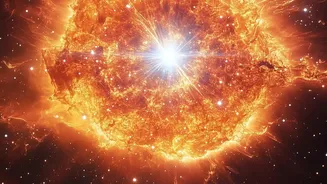
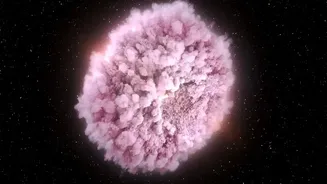
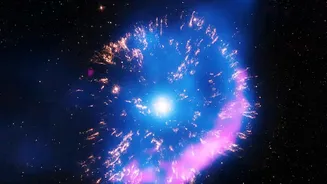
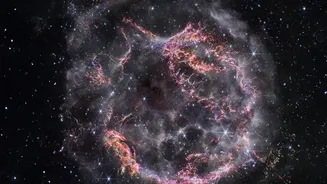
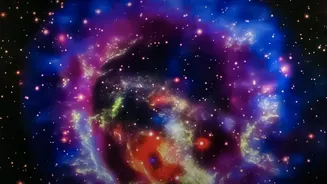
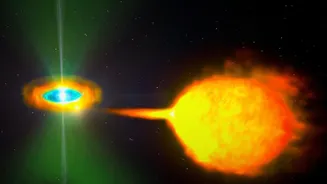
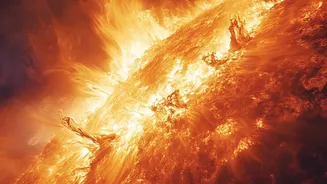
When a star many times the mass of our Sun runs out of fuel, its core collapses under its own immense gravity. This collapse forms an ultra-dense neutron star. In theory, the shockwave from this collapse should blast the star's outer layers into space
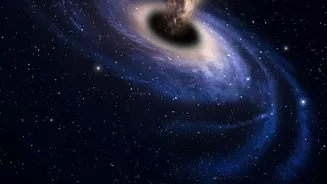
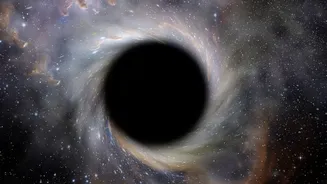
in a brilliant supernova. The problem is, for decades, scientists' models showed this shockwave stalling, fizzling out before it could trigger the explosion. It was like a car engine that would crank but never turn over. This meant something was missing from the equation, a hidden factor that gives the shockwave the extra push it needs to succeed. Without this push, many massive stars would simply collapse into black holes without the spectacular firework display that seeds the universe with heavy elements.
Enter the Ghost Particle
The prime suspect for this missing ingredient is the neutrino, an elementary particle with bizarre properties. Neutrinos are incredibly light, have no electrical charge, and barely interact with other matter. Trillions of them pass through your body every second without you ever noticing. During a star's core collapse, an unimaginable number of neutrinos are created, carrying away about 99% of the explosion's total energy. For a long time, it was thought their role, while energetic, might not be the deciding factor in the explosion itself. The new research challenges this assumption, suggesting these 'ghost particles' are not just bystanders but key players that determine whether a star explodes or collapses into a black hole.
The Power of Supercomputing
Simulating the inside of a dying star is one of the most difficult tasks in science. The physics involved is incredibly complex, involving gravity, nuclear reactions, and the behaviour of matter at temperatures and densities beyond our comprehension. This is where computer modelling comes in. Researchers at institutions like the University of Copenhagen have created sophisticated new simulations to test the role of neutrinos. Because the calculations are so computationally expensive, they had to develop simplified but powerful models to run scenarios for hundreds of stars with different masses. These models allowed them to do something previous attempts struggled with: incorporate the strange physics of neutrinos, including their ability to change 'flavour'.
A Flip of the Cosmic Coin
The latest simulations, published in the journal Physical Review D, revealed something startling. By including the process where neutrinos change from one type (or 'flavour') to another, the fate of many stars flipped entirely. The researchers simulated 195 stars, ranging from 9 to 120 times the mass of our sun. They found that for stars in a specific mass range (about 16 to 30 times our Sun), including neutrino flavour-changing often meant the difference between a successful supernova explosion and a failed one that creates a black hole. In many cases, stars that were expected to explode spectacularly instead collapsed quietly when the full effects of neutrino physics were included in the model. This suggests that these tiny, elusive particles have a powerful, direct influence on the outcome.
Why This Changes Everything
This discovery could solve several long-standing cosmic mysteries. For one, it might explain why astronomers have observed fewer supernovae in the universe than our theories predicted. If more stars are collapsing directly into black holes, it would account for the missing explosions. More importantly, it refines our understanding of how the universe is built. Supernovae are the cosmic forges that create and distribute heavy elements like gold, oxygen, and iron—the very elements that make up our planet and ourselves. By understanding exactly which stars explode and why, we get a clearer picture of our own cosmic origins. These simulations provide compelling evidence that to understand the largest events in the universe, we must first understand the behaviour of its smallest, most mysterious particles.