



A New Eye on the Cosmos
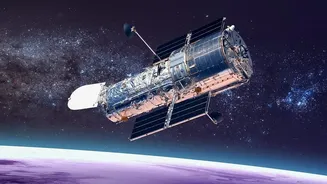
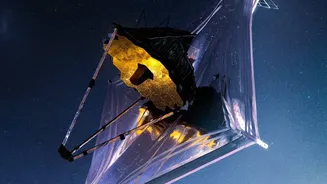
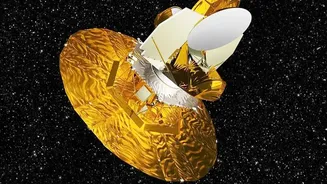
Set to join the ranks of Hubble and the James Webb Space Telescope, the Nancy Grace Roman Space Telescope is a next-generation observatory with a unique mission. Named after NASA’s first chief of astronomy, Nancy Grace Roman, this telescope has a 2.4-meter
primary mirror, the same size as Hubble's, but it's engineered for a completely different approach to cosmic observation. Its primary goals are to tackle two of the biggest questions in modern astronomy: the nature of mysterious dark energy and the census of planets beyond our solar system, known as exoplanets. To do this, Roman is equipped with two main instruments: the Wide-Field Instrument and the Coronagraph Instrument, each providing a distinct but complementary function.
The Power of a Panoramic View
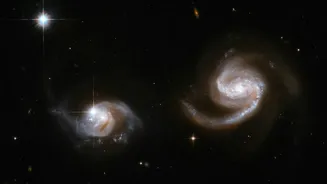
The game-changing feature of the Roman telescope is its Wide-Field Instrument. Imagine trying to take a picture of a vast landscape through a keyhole; that's similar to how telescopes like Hubble often operate, capturing stunningly deep but narrow views. Roman, by contrast, throws the door wide open. Its field of view is at least 100 times larger than Hubble's infrared instrument, allowing it to image huge patches of the sky with the same high resolution. What would take Hubble hundreds of years to survey, Roman can accomplish in a fraction of the time. This incredible survey speed is what enables its ambitious science goals. It will map the distribution of billions of galaxies across cosmic time, providing a massive dataset for scientists to work with.
From Big Picture to Fine Detail
While the Wide-Field Instrument captures the grand scale of the universe, Roman’s second tool, the Coronagraph Instrument, is designed for extreme close-ups. It’s a technology demonstration of a system of masks, mirrors, and detectors that block the overwhelming glare of a star. Doing so reveals the much fainter light of planets orbiting it. This will allow astronomers to directly image large, Jupiter-sized exoplanets for the first time with such clarity. The Roman Coronagraph is expected to be 100 to 1,000 times more powerful than previous space-based coronagraphs, paving the way for future missions like the Habitable Worlds Observatory, which aims to one day image Earth-like planets.
Unraveling the Mystery of Dark Energy
About 68% of the universe is made of dark energy, a mysterious force causing the universe's expansion to accelerate. Scientists know it's happening, but they don't fully understand why. Roman will tackle this enigma using three powerful techniques. It will conduct a massive survey of galaxies to see how their distribution has been influenced by dark energy over time. It will also observe thousands of Type Ia supernovae, which act as 'standard candles' to measure cosmic distances and the rate of expansion. Finally, it will map dark matter by studying how the gravity of massive structures subtly bends the light from distant galaxies, a phenomenon known as weak gravitational lensing. Together, these methods will provide the most detailed map yet of how dark energy has shaped our universe.
Taking a Census of Distant Worlds
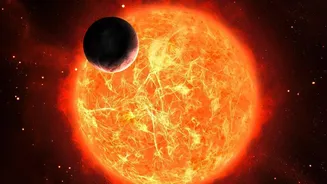
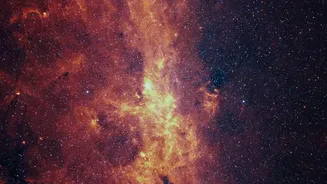
Beyond studying dark energy, Roman will embark on a massive exoplanet hunt. Its wide-field camera will continuously monitor hundreds of millions of stars toward the dense center of our galaxy. By doing this, it will look for tiny, temporary brightenings of a star caused by the gravity of another star and its planets passing in front of it—a technique called gravitational microlensing. This method is sensitive to planets of various sizes, including those with masses as low as a fraction of Earth's and those on wide orbits, far from their star. It will also find rogue planets, which drift through space unbound to any star. Scientists estimate that Roman's survey could discover thousands of new exoplanets, creating a statistical census that will revolutionize our understanding of planet formation.