





A Cosmic First Responder
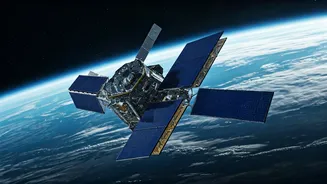
The observatory in question is the Neil Gehrels Swift Observatory, a space telescope launched in 2004 with a unique and vital mission: to hunt for gamma-ray bursts (GRBs). These are the most powerful explosions in the universe, releasing more energy in seconds
than our Sun will in its entire lifetime. For years, Swift has acted as a cosmic first responder. Its special ability is its speed; true to its name, the observatory can autonomously detect a GRB and pivot its three telescopes—gamma-ray, X-ray, and ultraviolet/optical—to the source within about a minute. This rapid response allows scientists on Earth to quickly point other ground and space-based telescopes to study the fading afterglow, unlocking secrets about the birth of black holes and the collision of neutron stars. Swift's discoveries have been fundamental to modern astronomy, including playing a key role in studying the source of gravitational waves, heralding a new era of multi-messenger astronomy.
What Went Wrong?
After more than 20 years of faithful service, Swift's orbit is decaying. The primary culprit is the Sun. Recent intense solar activity has caused Earth's upper atmosphere to expand, or "puff up." This creates more atmospheric drag on satellites in low-Earth orbit. For an aging, propulsion-less observatory like Swift, this drag acts like a constant brake, pulling it closer to Earth. Its orbit has already dropped from its original altitude of about 600 kilometres down to around 360 kilometres. If nothing is done, projections show it will fall below a critical point of no return later this year, after which it would be doomed to burn up upon re-entry into the atmosphere. To slow the decay, NASA has already suspended science operations to place the observatory in a low-drag configuration, but this is only a temporary fix.
The Daring Rescue Plan
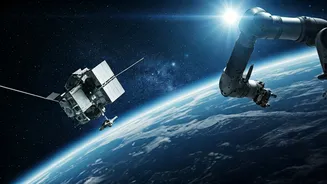
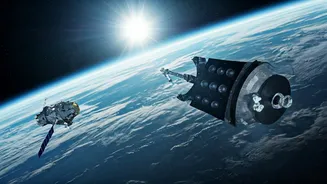
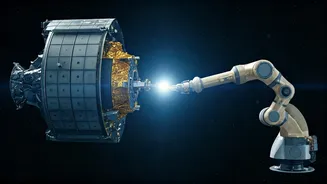
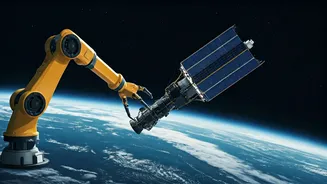
Replacing Swift would cost hundreds of millions of dollars and take years, leaving a critical gap in our astronomical capabilities. So, NASA is opting for a more audacious and cost-effective solution: a rescue mission. The space agency has awarded a $30 million contract to a private company, Katalyst Space Technologies, to build and launch a robotic servicing spacecraft called LINK. The launch, scheduled for July 1 aboard the final flight of the historic air-launched Pegasus XL rocket, will send LINK into an orbit near Swift. The mission is the first of its kind for the United States. The refrigerator-sized LINK robot will then spend about a month tracking and approaching Swift. Once it gets close, it will use its three robotic arms to carefully grapple onto the observatory—a satellite that was never designed to be serviced.
The Race Against Time
Once LINK has a firm grip, the real work begins. Over the course of several months, the robotic spacecraft will use its own gentle thrusters to slowly and carefully boost Swift back up to a higher, more stable orbit of about 600 kilometres. The entire operation is fraught with risk. The LINK robot must autonomously locate and grab onto a satellite it has never seen up close, a task one official estimated has a 50-50 chance of success. However, the potential reward is immense. A successful boost would extend Swift's operational life for many more years, allowing it to continue its invaluable work observing the universe's most extreme events. After the launch was postponed a day due to weather, the mission is now targeting July 1 for its high-stakes attempt to give this veteran observatory a new lease on life.