





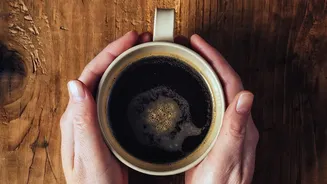
It Starts With Your Genes
Your preference for a strong, black brew might actually be hardwired into your DNA. Research from Northwestern University suggests that people who prefer black coffee often have a specific genetic variant that allows them to metabolise caffeine faster.
Because the stimulating effects wear off more quickly, they are driven to drink more coffee. Over time, these individuals learn to associate the bitter taste of coffee with the mental boost they get from caffeine, turning a flavour many find challenging into something they actively seek out. This means it's not necessarily about loving the bitterness itself, but about what your body has learned that bitterness signals: a welcome jolt of energy.
The Health Equation
From a health perspective, the camps are quite distinct. Black coffee is the clear winner on the calorie front, with a standard cup containing fewer than five calories. It's also packed with antioxidants like polyphenols, which are linked to a lower risk of several conditions, including type 2 diabetes and certain liver diseases. On the other side, adding milk and, especially, sugar changes the nutritional profile significantly. While milk adds calcium and some vitamins, it also adds calories and fat. Sugar is the main culprit, increasing your daily intake and potentially counteracting some of coffee's inherent benefits, like improved insulin sensitivity. Studies have shown that the mortality benefits associated with coffee are strongest for those who drink it black or with minimal additions.
A Tale of Two Cultures in India
The coffee divide in India also reflects a cultural evolution. For generations, the quintessential Indian coffee experience has been the South Indian filter coffee—a decoction typically served with plenty of milk and sugar. This sweet, milky beverage is a staple in households and a cultural institution promoted by chains like the Indian Coffee House. However, recent decades have seen a surge in a new coffee culture, driven by global chains and homegrown artisanal roasters. This movement has popularised espresso-based drinks like the Americano and the simple pour-over, bringing black coffee from a niche preference to a mainstream choice, especially among younger, urban demographics. It represents a shift from coffee as a traditional comfort drink to coffee as a statement of modern taste.
What Your Cup Says About You
While it's fun to speculate, the idea that your coffee order is a definitive personality test should be taken with a pinch of salt. Some small studies have drawn correlations between a preference for black coffee and traits like straightforwardness, efficiency, and a no-nonsense attitude. One study even famously linked a preference for bitter tastes to antisocial personality traits, but this is a weak correlation, not a diagnosis. Similarly, those who enjoy sweeter, milkier coffees are sometimes described as more easy-going, social, and comfort-seeking. However, these are broad generalisations. A preference for a simple black coffee could just as easily be about appreciating the unadulterated flavour of the bean, while a latte could simply be a desire for a comforting treat.