


A New Cartographer in Space
NASA's Interstellar Mapping and Acceleration Probe, or IMAP, is a state-of-the-art observatory designed for a singular, grand purpose: to map the invisible boundaries of our solar system. Launched in late 2025, the spacecraft is now operational from its
vantage point about 1.6 million kilometers from Earth, a stable location where it can intercept particles from the Sun and from interstellar space. The mission's recent release of its first public science data marks a major milestone. While not a single bombshell discovery, this initial dataset from seven of its ten instruments is the starting gun for a new era of exploration, allowing scientists worldwide to begin piecing together the most comprehensive picture yet of our immediate cosmic neighborhood.
The Heliosphere: Our Protective Bubble
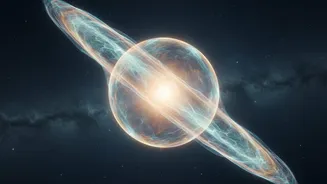
Our solar system isn't just floating naked in the galaxy. It's enveloped by the heliosphere, a massive bubble inflated by the solar wind—a constant stream of charged particles flowing from the Sun. This bubble acts as a crucial shield, deflecting a significant amount of high-energy galactic cosmic rays that would otherwise bombard the planets. Without the heliosphere, life on Earth might have evolved very differently, if at all. The boundary of this bubble, called the heliopause, is where the outward push of the solar wind comes to a stalemate with the inward pressure of the interstellar medium—the mix of gas, dust, and plasma that fills the space between stars. It is this distant, complex, and dynamic frontier that IMAP was built to study.
The Lingering Questions from Voyager
Our only direct contact with this boundary came from the legendary Voyager 1 and Voyager 2 spacecraft. After decades of travel, they punched through the heliopause, confirming its existence and providing the first-ever in-situ measurements. But their journey raised as many questions as it answered. The probes were like two tiny needles piercing a colossal balloon, giving us only two points of data. We learned that the boundary is not a simple, static wall, but a turbulent and complex region. IMAP's mission is fundamentally different. Instead of flying through the boundary, it will map the entire thing from a distance. It does this by detecting particles called Energetic Neutral Atoms (ENAs) that are created at the edge of the heliosphere and travel all the way back toward Earth. These ENAs are cosmic messengers, carrying information about the conditions at the far-flung frontier from which they came.
What the First Data Represents
So, what does this first public data from IMAP actually show? It's the beginning of a long-term observational campaign. Instruments have been switched on, calibrated, and are already measuring the flow of the solar wind, the composition of interstellar dust particles, and the magnetic fields weaving through space. Data from instruments like the Solar Wind Electron (SWE) instrument have already captured the effects of a solar storm passing by. The release gives scientists a baseline—a starting point from which all future discoveries will be measured. It’s the first few brushstrokes on a canvas that will eventually reveal a complete, 3D map of our solar system’s interaction with the galaxy. This is more than just an academic exercise; understanding this boundary is key to predicting space weather, which can affect satellites, power grids, and even astronauts on future missions to the Moon and Mars.