




The Universe’s Greatest Mystery
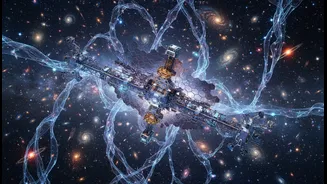
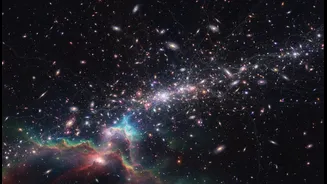
Imagine trying to understand a city by only looking at its streetlights. You’d see the bright spots, but you would miss the buildings, the roads, and the people that make up the metropolis. Astronomers face a similar problem. Everything we can see—stars,
planets, and galaxies—accounts for only about 5% of the universe. The rest is a combination of dark energy and, more mysteriously, dark matter. Scientists are certain dark matter exists because they can see its immense gravitational effects. It is the invisible 'cosmic glue' that prevents galaxies from flying apart as they spin. Despite making up about 85% of all matter, its true nature remains one of the biggest open questions in modern physics. We know it's there, but we have no idea what it is.
Searching in the Dark
The hunt for dark matter has led scientists to build some of the most sensitive experiments ever conceived. Many of these are buried deep underground to shield them from cosmic rays and other background radiation. These experiments typically use large tanks of a noble gas, like liquid xenon, as a target. The theory is that as Earth moves through the galaxy, it is constantly streaming through a 'wind' of dark matter particles. Occasionally, one of these particles should collide with an atomic nucleus in the detector, creating a tiny, detectable flash of energy. The problem is, these collisions are incredibly rare and faint. Lighter dark matter particles, in particular, would create such a tiny nuclear recoil that it would be below the detection threshold of most experiments, making them effectively invisible. After decades of searching, no experiment has yet made a definitive detection.
A Quantum Clue from the Past
The 'Sheffield model' in the headline actually refers to global efforts, including those at Sheffield, to harness a quantum phenomenon first predicted in 1939 by Russian physicist Arkady Migdal. The 'Migdal effect' suggests that when a particle like dark matter gives a sudden jolt to an atomic nucleus, there is a small chance the atom will also emit a high-energy electron. For decades, this effect was largely a theoretical curiosity. But physicists realized it could be a game-changer for dark matter detection. While the tiny jolt to the nucleus might be too small to see, many detectors are much better at spotting the ejected electron. This process essentially acts as a quantum amplifier, turning an unobservable event into a detectable one. It could dramatically boost sensitivity to the low-mass dark matter particles that other methods miss.
From Theory to Focused Experiments
Harnessing the Migdal effect allows physicists to design more focused experiments. Instead of just searching for one type of signal (the nuclear recoil), they can now search for a distinctive, two-part signature: a recoiling nucleus and a simultaneously ejected electron. This provides a powerful way to filter out background noise. Recent work from University of Sheffield scientists, including Dr. Yu-Dai Tsai, explores related concepts like 'dark matter resonance'. This theory proposes that dark matter may exist in a hidden fifth dimension and that its geometry naturally 'tunes' particles to interact more strongly at certain times, like the early universe, while remaining elusive today. This kind of theoretical work provides clear new targets. It tells experimentalists what particle masses to look for and what kind of signals to expect, allowing them to fine-tune their detectors and analyses. This avoids a purely brute-force search and makes the hunt for dark matter more efficient.
The Next Generation of a Global Search
Scientists at Sheffield, including Professor Vitaly Kudryavtsev, are deeply involved in major international dark matter projects like LZ (LUX-ZEPLIN) and the Deep Underground Neutrino Experiment (DUNE). The insights from theoretical models about the Migdal effect and dark matter resonance are already being applied to data from these experiments. For instance, the XENON1T experiment used a Migdal effect analysis to set new limits on low-mass dark matter. While this is not a discovery of dark matter itself, it's a crucial step forward. By confirming and measuring these subtle quantum effects, collaborations like the MIGDAL experiment are paving the way for the next generation of detectors. These new theoretical maps are guiding researchers toward the most promising places to look, increasing the chances that they might finally shed light on one of the universe's darkest secrets.