

Our Familiar Magnetic Shield
First, a quick refresher on the basics. A magnetosphere is a vast, invisible shield created by a planet's magnetic field. On Earth, this field is generated by the churning of its molten iron core. This shield deflects the solar wind—a constant stream
of charged particles from the Sun—protecting our atmosphere and making life possible. The solar wind's pressure shapes our magnetosphere, creating a compressed 'dayside' facing the Sun and a long 'nightside' tail stretching out behind us. A key feature is the magnetic 'cusp', an opening near the pole that typically faces the Sun around noon, where solar particles can funnel into our atmosphere, creating auroras.
Cassini's Ghostly Data
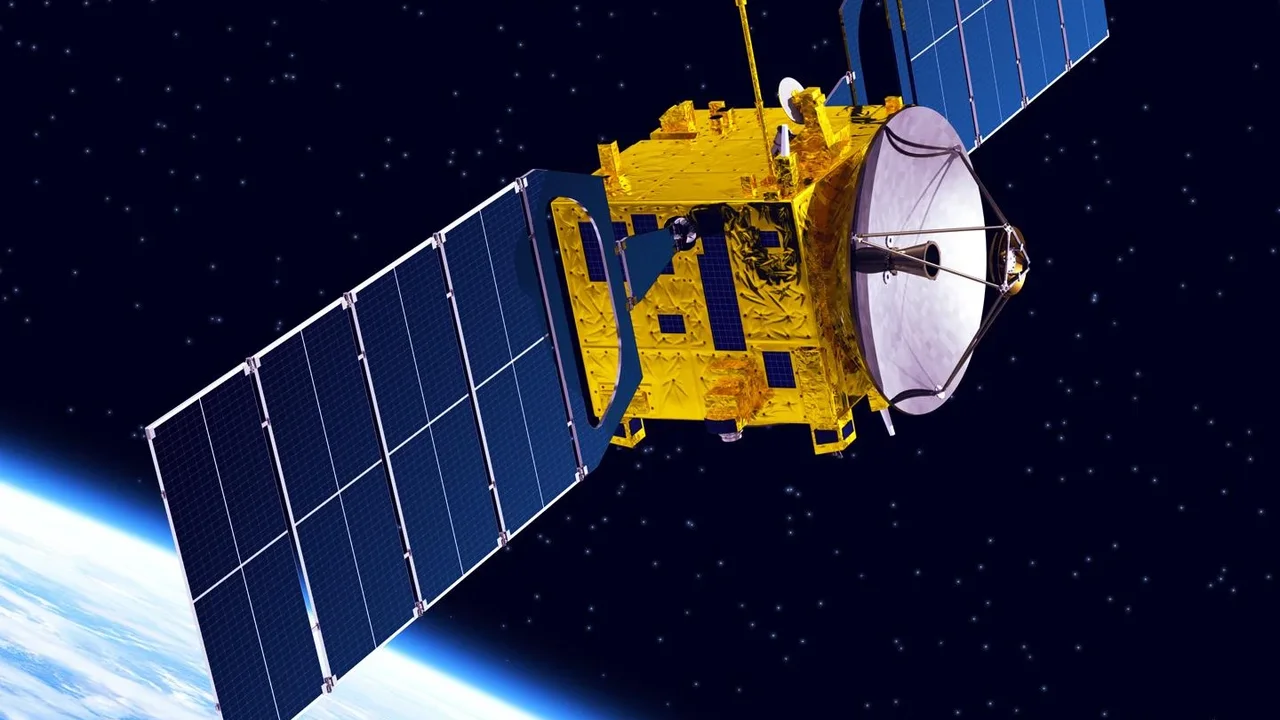
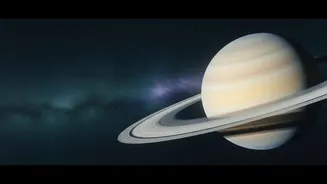
The Cassini-Huygens mission, a joint project of NASA, the European Space Agency (ESA), and the Italian Space Agency (ASI), orbited Saturn from 2004 to 2017. Even years after the spacecraft's dramatic final plunge into Saturn's atmosphere, scientists are still mining its rich dataset for new discoveries. A recent analysis published in Nature Communications does just that, focusing on six years of data from Cassini's instruments to map Saturn's magnetosphere in unprecedented detail and confirm long-held theories about how giant planets work.
Saturn's Two Big Differences
The new analysis highlights two fundamental ways Saturn’s system is unlike Earth’s. First, its magnetic field is almost perfectly aligned with its rotational axis, with a tilt of less than one degree. Earth's magnetic axis is tilted by about 11 degrees, which is what causes our magnetic poles to wander. Saturn’s strange alignment defies current theories about how planetary magnetic fields are generated. Second, Saturn spins incredibly fast (a day is under 11 hours) and it has a powerful internal engine for its magnetosphere: its moons. Specifically, the moon Enceladus spews massive plumes of water vapor into space, which become ionized and form a heavy 'soup' of plasma that the planet drags around as it spins.
A Lopsided, Internally Driven Shield
This is where the new analysis provides a twist. On Earth, the solar wind is the main force shaping our magnetosphere. But at Saturn, the planet's own rapid rotation and the plasma from Enceladus are the dominant factors. These immense internal forces effectively overpower the Sun's influence. The most surprising finding from the new data is that Saturn's magnetic cusp—the opening to the solar wind—isn't found at the 'noon' position like on Earth. Instead, the planet's rotation drags the cusp far into the 'afternoon' side, typically between 1 and 3 p.m. local time. This confirms that Saturn's magnetosphere isn't just a bigger version of Earth's; it's a fundamentally different kind of beast, one driven from the inside out.
Why This Cosmic Comparison Matters
Understanding these differences is crucial for several reasons. It helps explain the powerful auroras at Saturn's poles, which are generated by processes more similar to Earth's despite the different shield structure. More importantly, it provides a new model for what magnetic fields might look like around other giant planets in our solar system and the thousands of exoplanets being discovered across the galaxy. By comparing the familiar workings of Earth with the strange, lopsided dynamics of Saturn, scientists can refine the fundamental laws that govern planetary systems everywhere. This knowledge is also vital for planning future missions, like a potential return to the Saturn system to investigate the habitability of its intriguing moons.