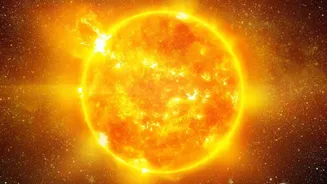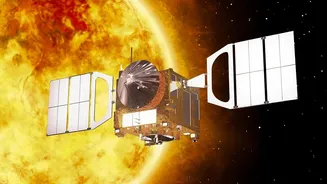




Perched 1.5 million kilometres away, India’s Aditya-L1 solar observatory is changing how we see our star. Its latest discovery unpacks a crucial detail about solar eruptions, revealing a new factor that shapes their journey towards Earth.
India’s Watchful Eye on the Sun
Since its launch
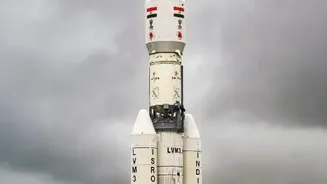
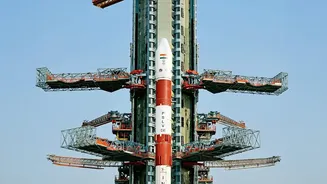
in September 2023, the Aditya-L1 mission has represented a monumental achievement for ISRO and India. Positioned in a halo orbit around the Sun-Earth Lagrange point 1 (L1), the spacecraft has an uninterrupted, continuous view of the Sun. This unique vantage point is critical for its primary mission: to study solar activity and improve our understanding of space weather. The spacecraft is equipped with seven sophisticated instruments designed to observe everything from the Sun's outermost layers to the particles it spews into space. Among these, the Visible Emission Line Coronagraph (VELC) is its primary payload, designed specifically to study the Sun’s corona, the super-hot outer atmosphere where explosive solar events originate.
The Myth of the Perfect Bubble
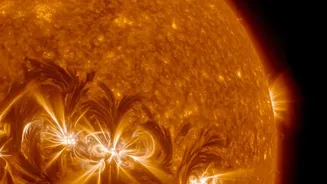
For years, scientists have often modelled Coronal Mass Ejections (CMEs)—colossal eruptions of plasma and magnetic fields from the Sun—as uniformly expanding bubbles. But new findings from Aditya-L1 are challenging this long-held assumption. In a study published in 'The Astrophysical Journal Letters', researchers from the Indian Institute of Astrophysics (IIA) analysed a CME that occurred on August 5, 2024. By combining data from VELC with images from NASA's Solar Dynamics Observatory and advanced 3D modelling, they discovered something profound: the eruption did not expand symmetrically. Instead, it grew unevenly, developing a tilted and asymmetric shape as it blasted away from the Sun.
Why the Shape of a Solar Storm Matters
This discovery is more than just an academic detail; it has significant implications for space weather forecasting. The shape of a CME directly influences how it travels through the solar wind, the constant stream of particles flowing from the Sun. An unevenly shaped eruption experiences different levels of resistance, or drag, as it journeys through space. This variation can alter its speed and trajectory, making it much harder for scientists to accurately predict when, or even if, it will arrive at Earth. A better understanding of this early-stage expansion, which Aditya-L1 is uniquely positioned to observe, is crucial for refining the models used to forecast the arrival of potentially disruptive solar storms.
The Tangible Threat of Space Weather
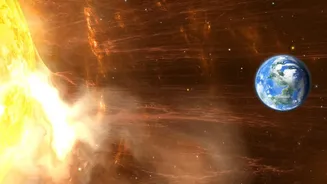
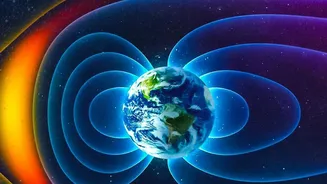
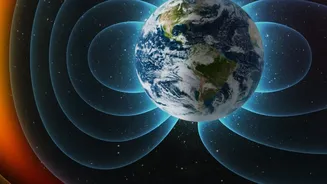
While the science may seem distant, the effects of space weather are very real and can be profoundly disruptive to our modern, technology‐dependent lives. A powerful CME hitting Earth can trigger a geomagnetic storm, a major disturbance of our planet's magnetic field. Such storms can induce damaging electrical currents in power grids, potentially causing widespread blackouts. They can disrupt satellite operations, affecting everything from GPS navigation and financial transactions to television broadcasts. Furthermore, these events can interfere with high‐frequency radio communications used by airlines and endanger astronauts in orbit with increased radiation.
A New Era in Solar Prediction
The breakthrough observation was made possible by VELC’s unique spectroscopic capabilities. Unlike a standard camera that just captures an image, VELC can measure the Doppler shift of the light from the erupting plasma. This allowed scientists to see that some parts of the CME were moving toward Earth while others were moving away simultaneously—a clear signature of a complex, three‐dimensional expansion. By demonstrating that CMEs have complex shapes from the very beginning, Aditya‐L1 has opened a new door for research. These findings not only showcase the cutting‐edge capabilities of Indian science and technology but also position India as a key player in the global effort to protect our planet from the Sun’s powerful outbursts.