
A Planet's Invisible Armour
Every planet with a magnetic field has a magnetosphere, a vast bubble of influence that deflects charged particles streaming from the Sun. Generated deep within a planet's core, this field is crucial. On Earth, it protects our atmosphere and enables life
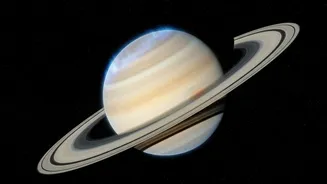
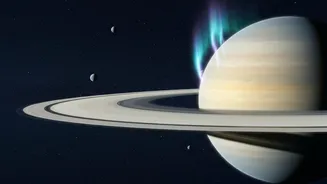
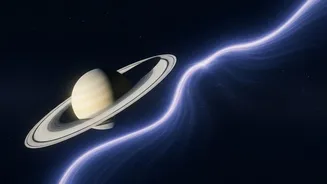
to thrive. It’s also responsible for the spectacular auroras at the poles, where the field funnels solar particles into the upper atmosphere. Our magnetosphere is relatively tidy and well-understood; it’s tilted slightly from our planet’s spin axis and is primarily shaped by the external pressure of the solar wind. For years, scientists assumed other planets followed similar rules, just scaled up or down. But new analysis of data from the Cassini spacecraft shows that Saturn breaks the mould in almost every way.
The Saturn Difference: An Axis of Mystery
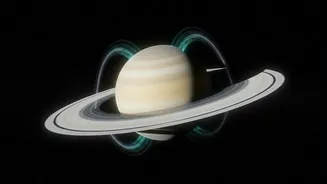
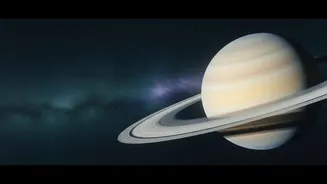
From the outset, Saturn’s magnetic field presented a puzzle. Unlike Earth, Jupiter, or any other planet with a global magnetic field in our solar system, Saturn’s field is almost perfectly aligned with its axis of rotation. This is a major challenge to dynamo theory, which suggests a tilt is necessary to sustain a magnetic field. But the oddities don't stop there. While Saturn's field is weaker at its cloud tops than Earth's, its overall magnetosphere is immense, stretching millions of kilometres into space. It’s also not an empty bubble. It is continuously filled with a huge amount of plasma—a soup of charged particles—but this material doesn't come from the Sun. Instead, it’s blasted into space from the icy geysers on Saturn’s small moon, Enceladus, which acts like a giant plasma generator inside the system.
A Lopsided Shield, Dragged by Rotation
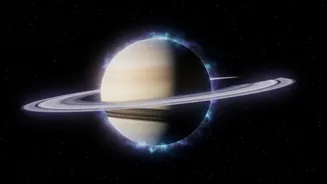
The latest analysis of Cassini data reveals just how strange Saturn’s shield is. Scientists looked for the 'cusps'—funnel-like openings near the poles where solar wind can leak into the atmosphere. On Earth, these cusps are located symmetrically around noon, directly facing the Sun. But at Saturn, they are significantly skewed. The new research shows Saturn’s cusps are consistently dragged toward the afternoon side, sometimes by several hours. What’s causing this lopsidedness? It’s a powerful combination of two internal forces: Saturn’s incredibly fast 10.7-hour rotation and the constant drag from the plasma cloud supplied by Enceladus. These internal forces are so dominant that they overpower the solar wind, twisting the entire magnetic structure. This confirms that Saturn’s magnetosphere is governed by a completely different set of rules than Earth's, shaped more from the inside out than the outside in.
Cassini's Grand Finale Revelations
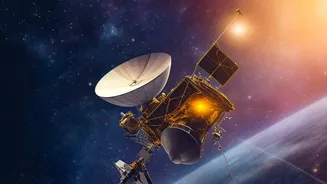
Before its dramatic plunge into Saturn’s atmosphere in 2017, the Cassini spacecraft performed a series of daring dives between the planet and its rings. This ‘Grand Finale’ provided an unprecedented look at the region. The data confirmed the magnetic field's bizarre symmetry and revealed an entirely new radiation belt nestled just inside the planet's innermost ring. Furthermore, Cassini directly sampled what scientists call 'ring rain,' a phenomenon where material from the rings is funnelled into the planet's atmosphere. It discovered a complex electrical circuit connecting the rings to the upper atmosphere, showing a far more intimate and complex relationship between the planet and its famous rings than ever imagined.
Why This Strange Shield Matters
Understanding Saturn's unique magnetosphere does more than just solve a planetary puzzle. It forces us to rethink how magnetospheres work across the galaxy. The discovery that a planet's rapid rotation and internal plasma sources can overpower the solar wind provides a new model for understanding the gas giants we are discovering around other stars. These distant worlds are often large and fast-spinning, so they may operate under the same 'Saturn-like' rules. Studying this strange system next door helps us understand the vast range of planetary environments that might exist and provides crucial context for future missions that will search for habitable conditions, perhaps even within our own solar system on moons like Enceladus.