









The AI Power Surge
The rise of generative AI has triggered an explosion in energy consumption that is reshaping the data centre industry. Unlike traditional computing, training and running complex AI models requires immense processing power, primarily from power-hungry
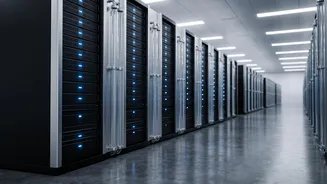
Graphics Processing Units (GPUs). A modern AI server rack can demand anywhere from 30 to over 100 kilowatts (kW) of power, a staggering increase from the 5-15 kW required for conventional racks. This surge in demand is straining local power grids, with projections showing global data centre electricity use could more than double between 2024 and 2030, largely driven by AI. Some estimates suggest that by 2030, the power demand from AI data centres alone will match that of all conventional data centres today. This has shifted the primary constraint for building new AI capacity from technology to the sheer availability of electricity.
A Question of Efficiency: Understanding PUE
To understand data centre efficiency, the key metric is Power Usage Effectiveness, or PUE. It’s a simple ratio: the total energy a facility consumes divided by the energy delivered to the IT equipment. A perfect score of 1.0 is physically impossible, as it would mean zero energy is used for cooling, lighting, or power conversion. A PUE of 2.0 means that for every watt that powers a server, another watt is lost to overhead. For years, the global average PUE has stagnated at around 1.54, meaning nearly a third of all power is used for non-computing functions. However, the industry's hyperscale giants like Google and Meta report fleet-wide PUEs as low as 1.08 or 1.09, showcasing what is possible with advanced design and massive investment. With new regulations in places like Germany mandating PUEs of 1.2 or lower for new builds, the pressure to improve is mounting across the entire sector.
The Heat Is On: The Cooling Challenge
The single biggest energy hog in a data centre, after the servers themselves, is cooling. All that electricity consumed by processors is converted into heat, which must be constantly removed to prevent equipment failure. Cooling can account for up to 40% of a data centre's total electricity use. Traditionally, this has been done with massive air conditioning systems. However, the extreme power density of AI racks is making air cooling insufficient and inefficient. The industry is now pivoting rapidly toward liquid cooling. This involves circulating fluids directly over hot components, which is far more effective at transferring heat. Some advanced systems use closed-loop liquid cooling that allows the facility to run at much higher temperatures, drastically reducing the energy needed for chilling and eliminating the massive water consumption associated with evaporative cooling towers. Beyond power, water usage is a growing concern, with projections suggesting AI's global water footprint for cooling and power generation could be enormous by 2027.
Innovating Toward a Sustainable Future
The challenge of powering AI is sparking a wave of innovation that goes beyond just PUE and cooling. Companies are rethinking every aspect of data centre design and operation. This includes developing more energy-efficient chips and investing in on-site power generation to bypass congested public grids. Some are building new facilities in colder climates to take advantage of 'free' air cooling, while others are co-locating them with renewable energy sources. However, there are significant hurdles. Building out grid infrastructure can take over a decade, far slower than the two to five years needed to construct a new data centre, creating a structural bottleneck. Furthermore, some efficiency gains are being offset by a 'rebound effect,' where improved performance simply drives even higher usage of AI services. The race is on to see if technological innovation can keep pace with AI's seemingly insatiable demand for resources.