
A New Generation of Martian Scout
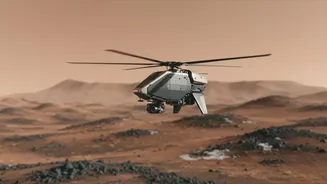
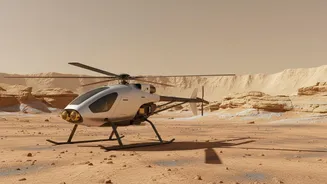
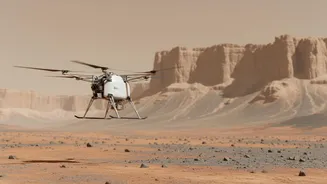
Building on the groundbreaking success of the Ingenuity helicopter, which proved powered flight was possible in the thin Martian atmosphere, NASA is developing its successor: the Skyfall mission. Managed by the Jet Propulsion Laboratory (JPL), this concept
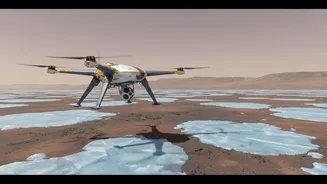
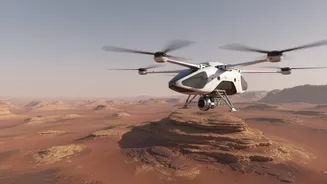
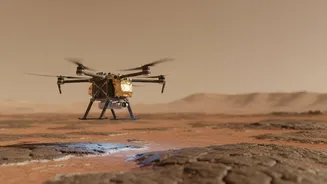
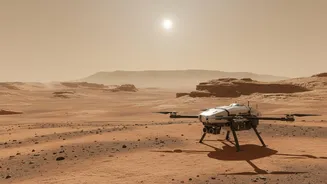
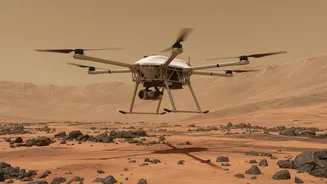
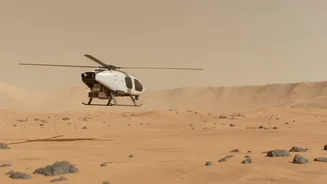
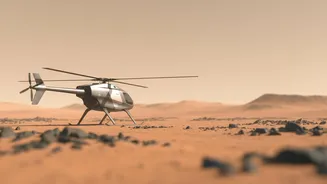
involves sending a trio of highly advanced helicopters to the Red Planet. Unlike Ingenuity, which was primarily a technology demonstration, the Skyfall helicopters are designed as dedicated scientific scouts. Their primary mission is to map subsurface water ice, a resource vital for future human outposts. The mission, currently slated for a potential launch in late 2028, represents a major leap forward, transforming aerial vehicles from novel experiments into essential tools for planetary exploration. An innovative deployment strategy will see the three helicopters released mid-air during descent, flying themselves to their first landing spots without the need for a protective lander.
Seeing Beneath the Surface
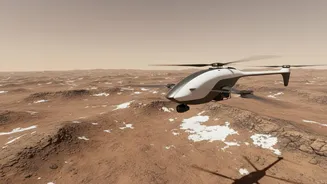
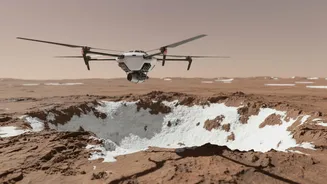
The key technology that makes Skyfall a game-changer is its ground-penetrating radar (GPR). While orbiters have mapped Mars for years, their radar can't resolve the top few feet of the subsurface, which is precisely where scientists expect to find accessible ice mixed with dust and rock. Each Skyfall helicopter will be equipped with a unique, lightweight radar antenna that looks like a small cape. This flexible antenna unfurls during flight, allowing the craft to fly low and slow, sending radar waves deep into the ground. This process can create high-resolution maps of underground layers, revealing the precise location and depth of ice deposits up to 16 feet below the surface. This data is crucial for identifying potential resources without having to land and drill, a much slower and riskier process.
Why Helicopters Are a Game-Changer
Rovers like Curiosity and Perseverance have been invaluable, but they are limited by their speed and the terrain they can traverse. A helicopter offers unparalleled mobility. It can cover far more ground than a rover, explore treacherous areas like cliffs and crater walls, and provide a bird's-eye view for mission planning. The Skyfall trio will be able to generate wide-area terrain and subsurface maps, identifying not only resource-rich zones but also safe landing sites for future human missions. This aerial scouting capability was hinted at during Ingenuity's operations, where it helped the Perseverance team plan efficient driving routes. Skyfall will take this to the next level, with each helicopter also carrying a 13-megapixel camera for 3D mapping and instruments to measure weather patterns.
Designing for the Red Planet
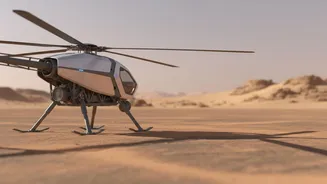
Flying on Mars is incredibly difficult. The atmosphere has only 1% of the density of Earth's, providing very little for rotor blades to push against to generate lift. To overcome this, helicopters like Ingenuity and the proposed Skyfall craft must have oversized blades that spin at incredibly high speeds—around 2,400 rpm or more, roughly five times faster than a typical helicopter on Earth. Power is another major constraint. The Skyfall helicopters will rely on solar-charged batteries, which must also provide enough energy to keep critical components warm during frigid Martian nights, when temperatures can plummet. The radar 'cape' itself presented an engineering puzzle: it needed to be flexible enough to withstand repeated landings but rigid enough to function as a precise antenna in flight, a challenge solved using durable materials like Vectran.
The Quest for Local Resources
Skyfall's mission is a critical step in the field of In-Situ Resource Utilization, or ISRU. ISRU is the concept of 'living off the land'—using local resources to support missions instead of hauling everything from Earth at enormous cost. Water ice is the ultimate prize in this endeavor. Once located and extracted, it can be purified for drinking, used to grow food, and split into hydrogen and oxygen. Oxygen is obviously essential for breathing, but both oxygen and hydrogen are also powerful rocket propellants. By mapping accessible ice deposits, Skyfall could literally draw the map for the first sustainable human presence on another planet, making long-term exploration and settlement an achievable reality.