

An Understudy Takes the Stage
Before NASA’s Lucy spacecraft could begin its primary mission—a 12-year tour of Jupiter’s mysterious Trojan asteroids—it needed to test its complex systems. The mission team required a practice target, a stand-in for the main events to come. They found
the perfect candidate in (52246) Donaldjohanson, a small asteroid in the main belt between Mars and Jupiter. While not one of Lucy’s primary targets, its convenient location along the spacecraft’s trajectory made it an ideal spot for a full dress rehearsal. The asteroid is named for Donald Johanson, the paleoanthropologist who discovered the famous “Lucy” hominin fossil, for which the mission itself is named.
The All-Important Dress Rehearsal
The flyby of Donaldjohanson on April 20, 2025, was far more than a simple photo opportunity; it was a crucial test of Lucy’s autonomous capabilities. As Lucy hurtles past its targets at over 48,000 kilometres per hour, there is no time for commands from Earth. The spacecraft must track the asteroid, aim its instruments, and collect data all on its own. The Donaldjohanson encounter was a full-scale test of this entire sequence. Following an earlier, simpler systems test at the asteroid Dinkinesh in 2023, this flyby was designed to mimic the exact procedures Lucy will use when it reaches the scientifically rich Trojan asteroids starting in 2027. The successful rehearsal proved the spacecraft is ready for its main mission.
A Target Full of Surprises
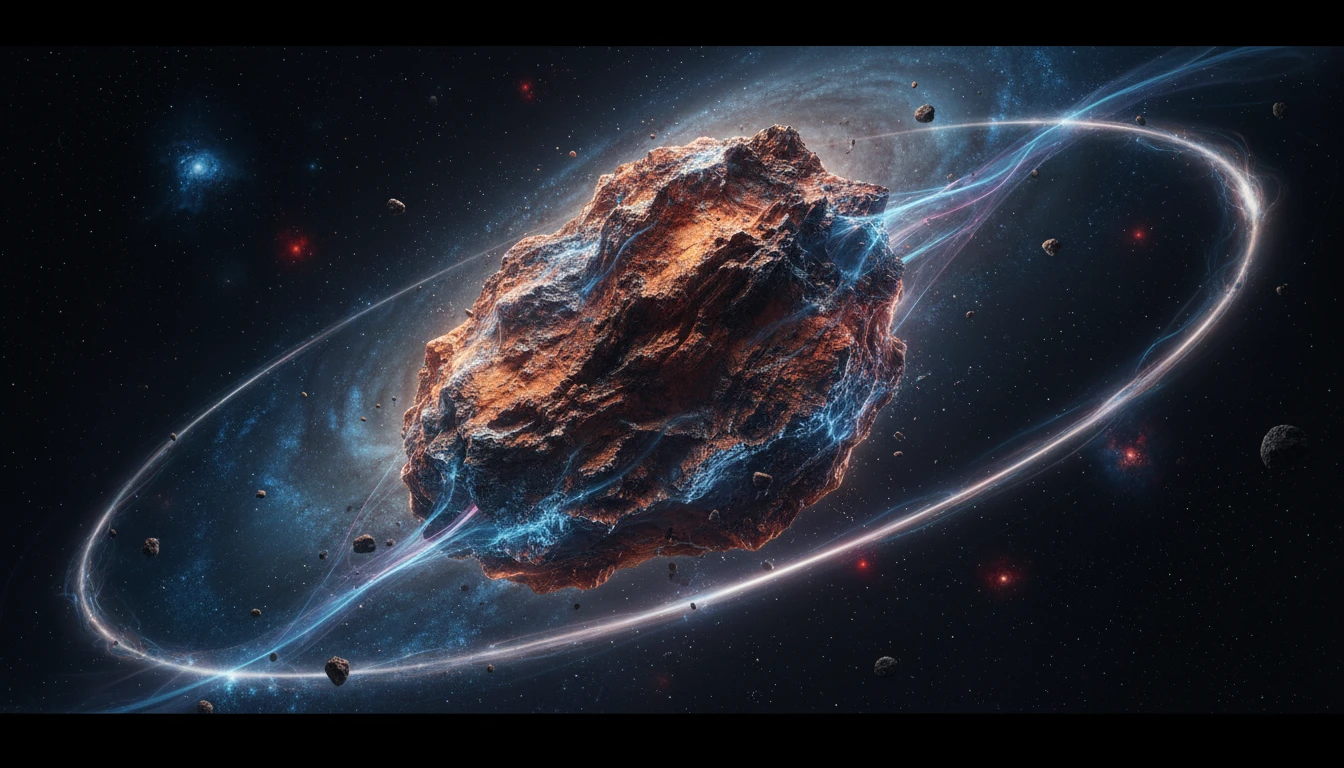
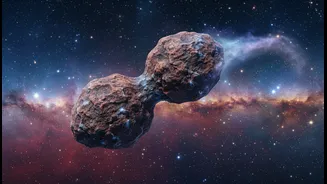
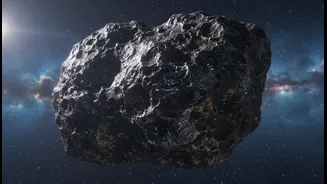
Scientists expected Donaldjohanson to be interesting, but the close-up images revealed a body with a surprisingly complex history. The asteroid is a “contact binary,” meaning it’s composed of two separate lobes that gently fused together long ago, giving it a distinct peanut-like shape. The object is about eight kilometres long and is believed to have formed from the fragments of a much larger parent asteroid that was shattered in a collision approximately 155 million years ago. Lucy’s images showed a cratered, lumpy world with a narrow neck connecting the two lobes, a structure one scientist likened to “two nested ice cream cones.” This geological complexity provides a rich dataset for understanding how small bodies in the solar system form and evolve.
The Scientific Value of a Stand-In
Beyond its role as a rehearsal target, Donaldjohanson delivered significant scientific returns. Data from the flyby revealed that the asteroid doesn't have a simple, stable spin; instead, it tumbles through space in a complex wobble. This unusual rotation is a clue to its violent origins. Furthermore, analysis of its surface composition has uncovered traces of ancient water, preserved in its rocky makeup from its long-gone parent body. This discovery links Donaldjohanson to other water-rich asteroids like Bennu and Ryugu, providing another key data point for scientists tracing the history of water and organic materials in our solar system. Even as a secondary target, it has proven to be a scientifically valuable destination in its own right.