




Our Cosmic Shield: The Heliosphere
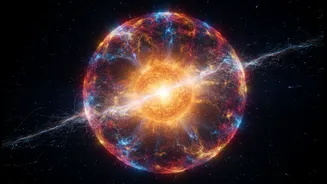
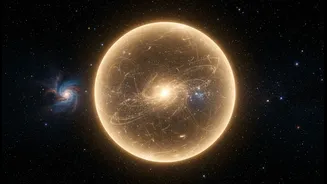
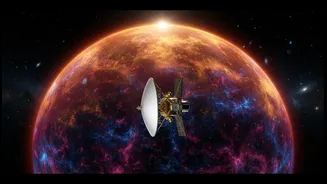
Imagine the solar system not as an empty void but as a vast bubble inflated by the Sun. This bubble is called the heliosphere. It's formed by the solar wind, a constant stream of charged particles flowing outward from the Sun at supersonic speeds. This bubble extends
far beyond the orbit of Pluto, creating a distinct environment that separates us from the rest of the galaxy, known as the interstellar medium. The heliosphere acts as a crucial shield, deflecting a significant amount of galactic cosmic rays (GCRs) — high-energy particles from exploded stars and other distant cosmic events. Without this protective barrier, life on Earth might have evolved very differently, if at all, due to the constant bombardment of damaging radiation.
The Intruders: Galactic Cosmic Rays
Galactic cosmic rays are the remnants of some of the most violent events in the universe, like supernovae. These particles, mostly atomic nuclei stripped of their electrons, travel at nearly the speed of light. While our heliosphere blocks many of them, some still manage to penetrate this magnetic shield, especially when the Sun is in a less active phase of its 11-year cycle. For us on Earth, our planet’s own magnetic field and thick atmosphere provide further layers of protection. However, for astronauts in deep space and for sensitive electronics on satellites, this radiation poses a significant threat. It can increase cancer risks, damage DNA, and cause malfunctions in critical space technology.
Meet the Investigator: The IMAP Probe
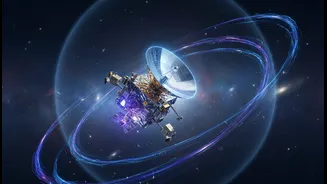
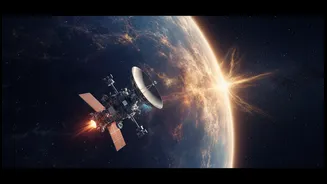
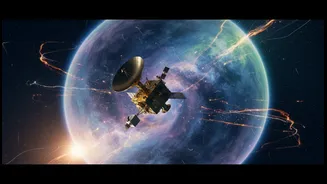
To better understand this cosmic interplay, NASA launched the Interstellar Mapping and Acceleration Probe, or IMAP. This mission is essentially a celestial cartographer, designed to create the first comprehensive maps of the heliosphere's boundary. After launching in September 2025, the IMAP spacecraft journeyed for several months to its operational orbit. On January 10, 2026, it successfully positioned itself at Lagrange point 1 (L1), a gravitationally stable spot about 1.5 million kilometres from Earth in the direction of the Sun. This unique vantage point allows IMAP an uninterrupted view of the Sun and the solar wind flowing outwards.
A Mission Toolkit for a Cosmic Mystery
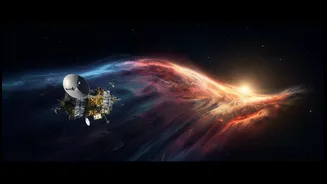
IMAP is equipped with a suite of ten advanced scientific instruments. These tools work together to sample particles in the solar wind, measure the magnetic fields they carry, and even catch particles of interstellar dust. A key part of its mission involves detecting "energetic neutral atoms" (ENAs). These are particles created at the edge of the solar system where the hot solar wind collides with the cold interstellar medium. Because ENAs are neutral, they are not deflected by magnetic fields and travel in straight lines, carrying information directly from the boundary to IMAP's sensors. By collecting these particles, scientists can piece together a picture of what's happening at the far-flung edge of our solar system without actually going there.
Why This Cosmic Puzzle Matters
Solving the mystery of how cosmic rays enter our solar system has profound practical implications. As humanity plans for long-duration missions to the Moon and Mars, understanding and predicting the radiation environment is critical for astronaut safety. IMAP's data will improve our space weather forecasting models. Its real-time monitoring of the solar wind provides advanced warnings of incoming solar particle events, giving astronauts and satellite operators precious time—about half an hour—to take protective measures. This research not only helps protect our technological assets and human explorers in space but also offers fundamental insights into our solar system’s place in the galaxy and the conditions that make a planet habitable.