



Why Are Himalayan Glaciers Unstable?
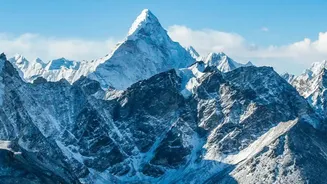
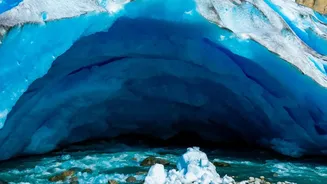
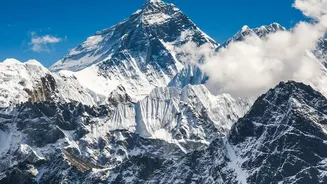
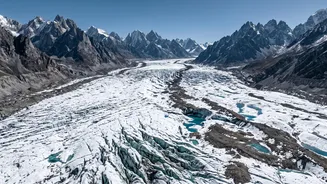
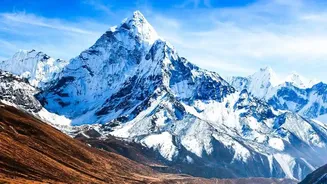
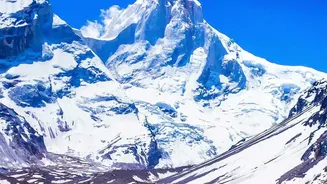
Himalayan glaciers are shrinking at an alarming rate due to climate change. According to the International Centre for Integrated Mountain Development (ICIMOD), glacier melt in the region has doubled since the year 2000. Temperatures in the Himalayas are rising
faster than the global average, leading to less snowfall and faster ice melt. This rapid melting not only reduces the size of the glaciers but also weakens their structure. Furthermore, as glaciers retreat, they no longer provide physical support to the steep mountain slopes, making them more prone to collapse. The combination of melting ice and thawing permafrost—the frozen ground that acts like cement for rocks and soil—creates a dangerously unstable high-altitude environment.
What Is a Glacial Lake Outburst Flood (GLOF)?
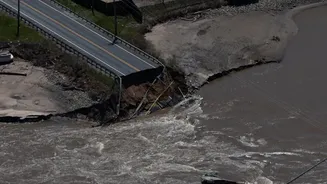
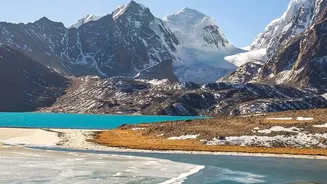
A Glacial Lake Outburst Flood, or GLOF, is a sudden and powerful flood that occurs when a lake formed by glacial meltwater breaches its natural dam. These dams are typically made of moraine—a loose pile of rock, sediment, and debris left behind by a retreating glacier. As glaciers melt, the volume of water in these lakes increases, putting immense pressure on the unstable moraine dams. An earthquake, a large rockfall, or even the sheer pressure of the water can cause the dam to fail, releasing a devastating torrent of water, ice, mud, and boulders that can destroy entire villages, bridges, and hydropower plants downstream. Nepal has experienced 26 GLOF events since 1977.
How Severe Is the Threat in Nepal?
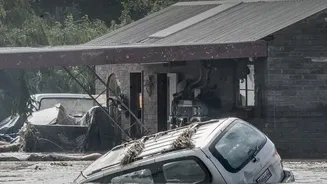
The threat is exceptionally high. A 2020 report from ICIMOD and the UNDP identified 47 potentially dangerous glacial lakes across Nepal, China, and India that pose a direct threat to downstream communities. Of these, 21 are located within Nepal. The Koshi river basin is considered the highest-risk area, containing 42 of the 47 identified lakes. These are not just abstract risks; a catastrophic flood in Nepal's Rasuwa district in August 2026, which killed over a thousand people, served as a grim reminder of the cascading dangers. While that event was a complex ice-and-rock avalanche, it highlights the multiple, interconnected threats facing the region. Experts warn that with thousands of glacial lakes in the country, the question is not if another disaster will strike, but when.
What Is the Link Between Glaciers and Landslides?
The connection is direct and dangerous. As glaciers melt and retreat, the ice that once buttressed steep valley walls disappears, leaving them unsupported and prone to collapse. Simultaneously, rising temperatures are thawing permafrost, which is the frozen soil and rock that glues mountain slopes together. When this permafrost thaws, the ground becomes saturated with water and loses its stability. This effect is worsened by shifting weather patterns that bring more intense rainfall instead of snow at high altitudes. This combination of unsupported slopes and weakened ground makes landslides, rockfalls, and massive debris flows more frequent and severe, sometimes interacting with glacial lakes to trigger even larger, cascading disasters.
What Is Being Done to Reduce the Risk?
Nepal, with support from international partners like the UNDP and the Green Climate Fund, is shifting from a reactive to a proactive approach. Key projects are underway to lower the water levels in the most dangerous glacial lakes, including Thulagi, Lower Barun, and Lumding Tsho. This involves complex engineering work, such as constructing controlled drainage channels. Alongside this, authorities are working to install and improve early warning systems, combining satellite monitoring with ground-based sensors to detect sudden rises in water levels or slope movement. Community-based disaster preparedness programs are also being implemented to educate and train local populations in vulnerable areas, ensuring that warnings can be communicated effectively to save lives. However, scientists caution that while these efforts are crucial, the scale and complexity of the problem across the vast Himalayan range remain a monumental challenge.