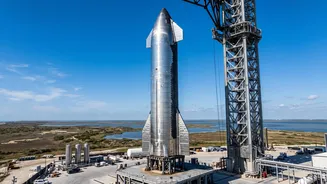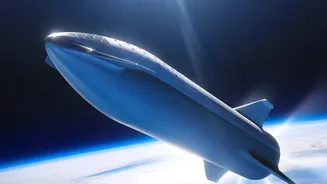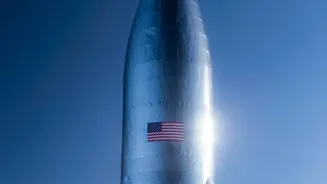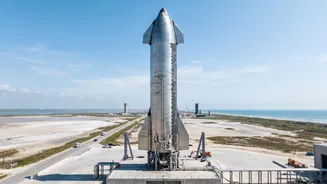



In a breathtaking maneuver, SpaceX successfully caught its massive Starship upper stage with giant mechanical arms after it returned from orbit. This historic achievement marks a pivotal moment in the quest for fully reusable rockets and cheaper access
to space.
A Mission of Mixed Results
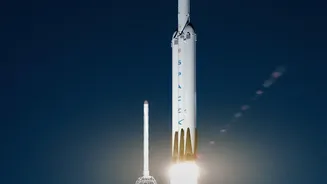
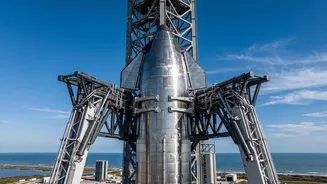
SpaceX's 15th Starship test flight was a tale of two stages with distinctly different outcomes. The primary success was the unprecedented recovery of the Starship upper stage, also known as the 'ship'. After launching on November 13, spending over 22 hours in orbit, deploying 26 Starlink satellites, and completing 14 revolutions of Earth, the spacecraft performed a controlled descent back to the Starbase facility in Texas. There, in a feat of engineering precision, it was caught by the launch tower's 'chopstick' arms. However, the mission's other major goal—recovering the Super Heavy booster—was not achieved. Shortly after liftoff, an issue prompted an abort of the booster's planned return to the launch tower. SpaceX reported that a low fuel mass alarm triggered the abort, and the booster was diverted for a splashdown in the Gulf of Mexico, where it was ultimately lost.
The 'Holy Grail' of Rocketry
For years, the concept of catching a returning orbital-class rocket with its own launch tower was purely theoretical. SpaceX has long described this capability as a critical breakthrough needed to make life multi-planetary. The system, nicknamed 'Mechazilla', is designed to eliminate the need for heavy landing legs on the vehicle itself and streamline the process of preparing it for its next flight. Successfully recovering the upper stage is significantly more challenging than recovering the booster. The ship returns from orbital velocity, meaning it must endure the extreme heat of atmospheric reentry before precisely navigating back to a fixed point on the ground and executing a complex landing flip maneuver to settle gently into the tower's arms. This successful catch is the first time any orbital-class upper stage in history has been recovered this way, turning a long-held ambition into a demonstrated reality.
Why Full Reusability Matters
The entire purpose of the Starship program is to create a launch system that is fully and rapidly reusable, much like a commercial airliner. Achieving this would drastically reduce the cost of access to space, which has historically been astronomical because rockets were traditionally discarded after a single use. By catching and reusing both the Super Heavy booster and the Starship upper stage, SpaceX aims to slash turnaround times and mission costs. This economic shift is fundamental to the company's business model and its most ambitious long-term goals. Cheaper launches would enable the faster deployment of its Starlink internet constellation and make large-scale projects, such as NASA's Artemis moon missions and Elon Musk's vision of a city on Mars, more financially viable. While the loss of the booster in this flight shows there is still work to do, the successful ship recovery is arguably the most difficult piece of that puzzle now solved.
Next Steps for Starship
Following the mixed but ultimately historic outcome of Flight 15, SpaceX engineers will be intensely focused on two parallel tasks. The first is a thorough investigation into the Super Heavy booster's failure to return. Understanding the root cause of the fuel alarm and preventing it in the future is now a top priority to achieve the full two-stage recovery. The second task involves inspecting the recovered Starship, known as Ship 42. Teams will analyze the integrity of its heat shield, engines, and structural components after its trip to orbit and fiery reentry. Elon Musk has already suggested the vehicle could potentially be refurbished and flown again within weeks, which would be another major first for the program. Future flights will aim to replicate the successful ship recovery while ironing out the issues with the booster catch, bringing SpaceX ever closer to routine, aircraft-like operations for its giant rocket.