






The Universe's Unseen Majority
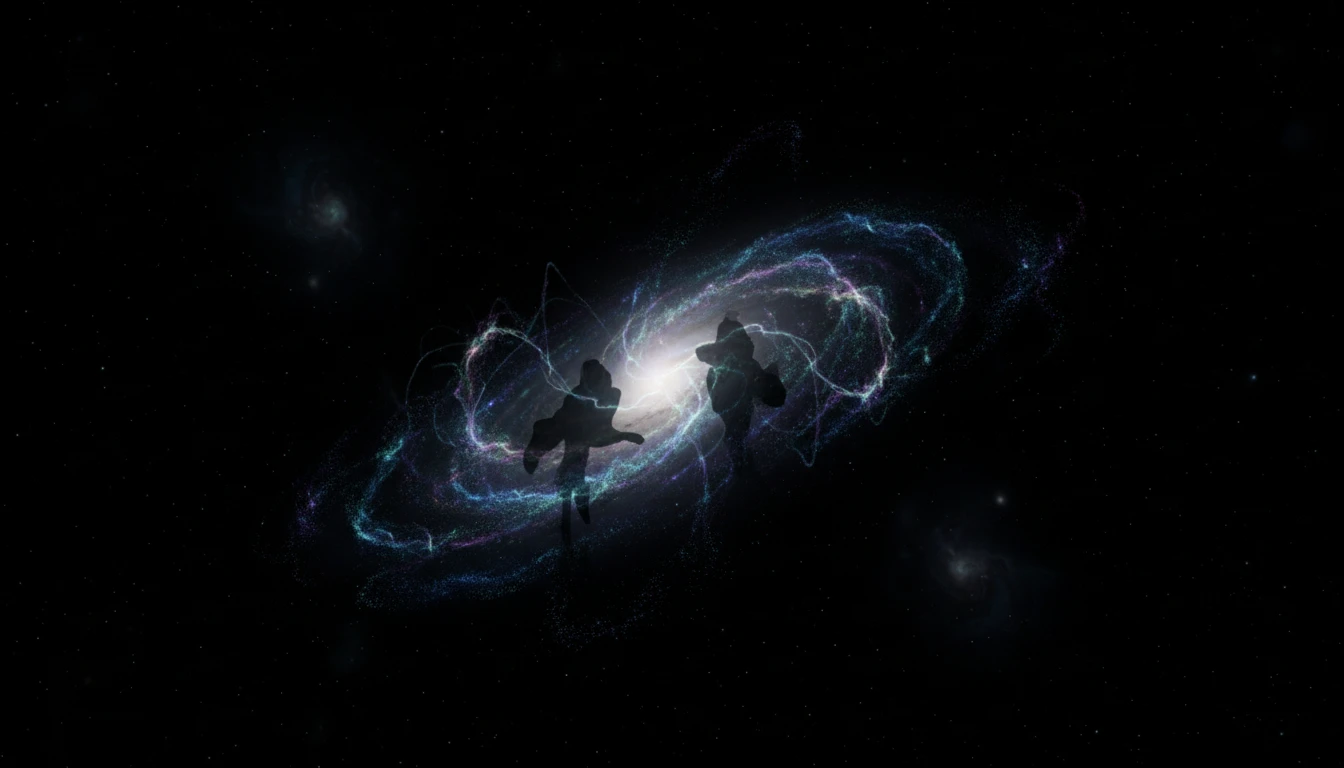
For decades, astronomers have seen the gravitational effects of something they cannot see. Galaxies rotate faster than they should, and light bends around seemingly empty space. The best explanation is dark matter, a mysterious substance that doesn’t
interact with light or any form of ordinary matter. We know it's there because of its gravitational pull, but we have never directly detected a single particle of it. This makes the search for dark matter one of the most pressing and profound challenges in modern physics. Finding it would not just confirm our theories, but open up an entirely new, hidden side of the cosmos.
A Portal to the Dark Sector
So, how can we find something that seems determined to stay hidden? Physicists have theorised the existence of a 'dark sector' with its own set of particles and forces, mirroring our own. A key part of this idea is the 'dark photon', a hypothetical cousin of the regular photon. While photons are the force carriers for electromagnetism in our visible world, dark photons could be the mediators for forces within the dark matter realm. More excitingly, theories suggest dark photons could act as a very weak bridge, or 'portal', between the dark sector and our own, offering a potential, if faint, way for us to peek into it.
Sheffield's Cosmic Blueprint
This is where the new calculations from physicists at the University of Sheffield come in. A recent theory published in the journal Physical Review D proposes a novel connection between dark matter, dark photons, and the very fabric of spacetime. The researchers suggest that dark matter could reside in a hidden fifth dimension. According to their model, the specific geometry of this extra dimension would cause dark matter particles to be in a special 'resonance' with dark photons. This resonance would have been much stronger in the early universe but would explain why dark matter is so hard to detect today. Most importantly, their calculations provide a theoretical blueprint, suggesting specific signatures that experimentalists can now search for.
A Treasure Map for Experiments
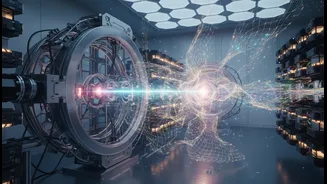
Theoretical work like this is crucial because it transforms the search for dark matter from looking for a needle in a cosmic haystack to a targeted hunt. The Sheffield calculations provide a kind of treasure map, telling experimental physicists what to look for and where. The specific signatures could be detected in experiments that use powerful magnetic fields or high-energy particle collisions, such as those at CERN. For example, experiments like FASER are already searching for dark photons produced in the Large Hadron Collider's collisions. The new calculations will help refine these searches and could even guide the design of future experiments specifically tuned to find these newly-predicted resonant effects.
From Theory to Potential Discovery
It's important to be clear: this is not a discovery of dark matter itself. Rather, it is a significant step forward in the scientific process. Theory provides the framework and predictions, which experimentalists then test against reality. The University of Sheffield's work has provided a compelling, testable hypothesis that connects multiple cutting-edge ideas in physics—from extra dimensions to dark sector particles. This new model is particularly appealing because it proposes that the necessary conditions for its theory arise naturally from the geometry of the universe, rather than requiring the artificial 'fine-tuning' seen in some previous models.