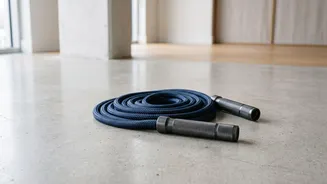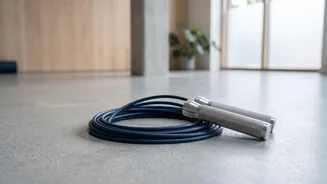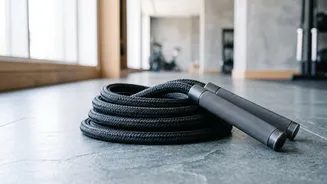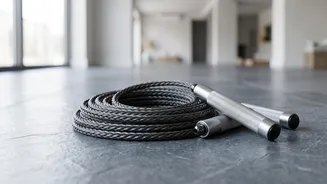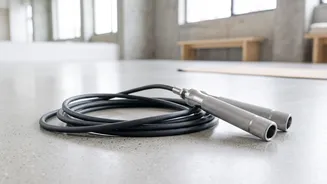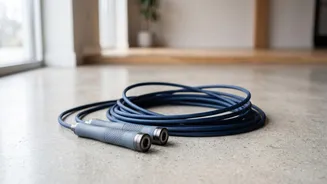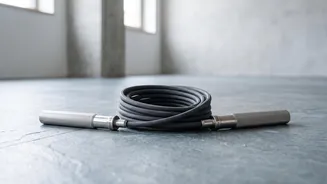






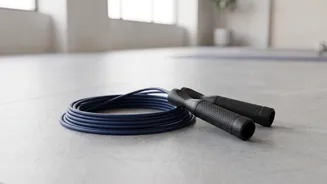
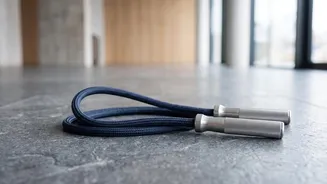

When choosing a cardio workout, we often focus on calories burned or endurance gained. But what about coordination? This complex skill is vital for performance and daily life. Let's break down how jump rope and running uniquely challenge it.
Understanding Coordination
Before we
pit jump rope against running, it's important to understand what coordination truly is. It’s more than just being graceful; it's a sophisticated neurological process. Coordination is the brain's ability to command multiple body parts to work together smoothly and efficiently. This involves timing, rhythm, balance, and proprioception—your body's sense of its position in space. Improving coordination means strengthening the connection between your mind and muscles, leading to better athletic performance and a lower risk of injury. Both jumping rope and running enhance this skill, but they do so by stressing different systems and movement patterns.
Jump Rope: A Symphony of Rhythm and Timing
Jumping rope is a masterclass in coordination. It demands a constant, high-speed dialogue between your hands, eyes, and feet. Your wrists must turn the rope at a consistent speed while your feet execute perfectly timed jumps to clear it. This rhythmic, repetitive motion intensely trains hand-eye-foot synchronicity. Furthermore, jump rope is a form of plyometrics, building explosive power and reactive strength in your lower legs. The real advantage for coordination, however, lies in its potential for varied movement patterns. While a basic bounce is simple, advanced techniques like double-unders, criss-crosses, and side swings introduce movements in multiple planes, forcing your neuromuscular system to adapt and respond with precision. This makes it an exceptional tool for developing whole-body control, agility and balance in a small, contained space.
Running: The Art of Unilateral Stability
Running, at its core, is a series of controlled, single-leg bounds. While it may seem more natural than jumping rope, it presents its own unique coordination challenges. The primary demand is unilateral stability—the ability to stay balanced and aligned while supported by one leg at a time. This requires constant, subtle adjustments from your core and hip muscles to prevent your pelvis from dropping and your torso from rotating excessively. Running primarily occurs in the sagittal plane (forward movement), with your arms swinging in opposition to your legs to maintain momentum and balance. This inter-limb coordination is crucial for an efficient gait. For runners, coordination isn't just about moving the limbs correctly; it's about economizing movement to conserve energy over long distances, which is a skill honed over many kilometres.
Movement Patterns and Proprioceptive Demands
The most significant difference between the two exercises lies in their movement patterns. Running is fundamentally a linear, forward-propelling activity. Its coordinative demands increase on uneven terrain, like a trail run, where your feet must constantly adapt to changing surfaces, significantly challenging your proprioception. Jump rope, conversely, is primarily a vertical movement but offers far more variability. By introducing different footwork and rope manipulations, you can train movement in frontal (side-to-side) and transverse (rotational) planes. This multi-planar movement is fantastic for developing the kind of agility useful in court sports, dancing, and martial arts. While both activities enhance proprioception, jumping rope does so through rapid, rhythmic impacts, while running does so through continuous adaptation to terrain and gait adjustments.
The Verdict: Different Tools for Different Skills
So, which is better for coordination? The answer depends entirely on your goals. Jump rope is superior for developing rhythm, timing, hand-eye-foot synchronicity, and multi-planar agility. Its constant feedback—tripping on the rope—makes it an immediate and effective teacher of precise motor control. If you want to be quicker on your feet, more agile, and develop a strong mind-muscle connection for complex skills, jumping rope is an unparalleled tool. Running excels at building unilateral stability, inter-limb coordination for forward momentum, and endurance. It teaches your body to be efficient and stable through thousands of repeated, single-leg stances. For improving running form and endurance-based coordination, nothing beats running itself. An ideal approach might be to incorporate both into your routine. Using a jump rope as a warm up or a dedicated training tool can improve a runner's foot speed and reactivity, while running can build the endurance base to support longer, more intense jump rope sessions.