





New Contracts for a Lunar Delivery Service
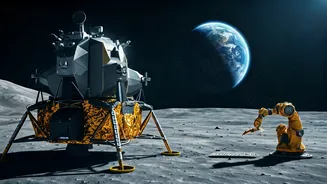
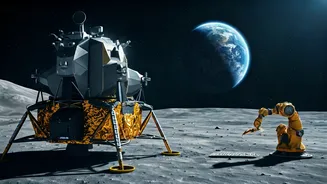
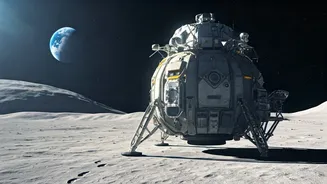
NASA has awarded nearly $600 million in contracts to three American companies: Astrobotic, Intuitive Machines, and Firefly Aerospace. The funding is for four uncrewed missions to land on the Moon in late 2028. Under the deals, Astrobotic will receive
$297.9 million for two deliveries, while Intuitive Machines and Firefly Aerospace will be paid $148.3 million and $144.2 million, respectively, for one mission each. This is part of NASA's Commercial Lunar Payload Services (CLPS) initiative, which treats NASA as a customer hiring private companies to transport cargo to the Moon. This approach is designed to accelerate the pace of exploration by fostering a commercial ecosystem and allowing NASA to focus on the bigger picture of science and human exploration.
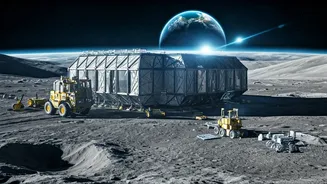
Paving the Way for a Moon Base
These robotic missions are not just one-off science trips; they are foundational steps for the Artemis program's long-term goal: establishing a permanent human presence on the Moon. The landers in 2028 will carry crucial scientific instruments and technology demonstrations to the lunar surface. Each of the four landers will carry an identical set of three NASA payloads. These include a stereo camera system to study how rocket plumes kick up lunar dust during landing, a laser retroreflector that will serve as a permanent navigational marker for future spacecraft, and a radiation monitor to measure the harsh environment and help design safer habitats for astronauts. By landing identical instruments at different locations, NASA can build a global network of environmental data, which is essential before sending people for long-duration stays.
What is the Artemis Program?
The Artemis program, named after the twin sister of Apollo in Greek mythology, is NASA's multi-stage plan to return astronauts to the lunar surface for the first time since 1972. After the uncrewed Artemis I test flight in 2022 and the crewed Artemis II lunar fly-by in 2026, the program is marching towards increasingly complex missions. While original plans shifted, Artemis IV, currently scheduled for early 2028, is now slated to be the first crewed lunar landing of the program. This will be followed by Artemis V in late 2028, which aims for a second landing and will begin the work of building a sustainable outpost. These 2028 robotic missions are critical for scouting and preparing the ground for the arrival of these astronauts.
Beyond Flags and Footprints
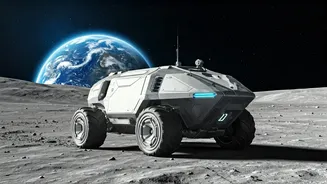
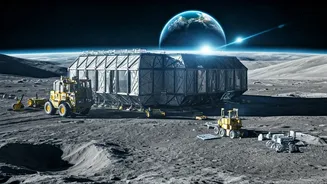
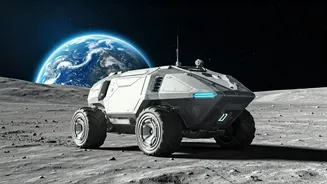
Unlike the Apollo missions of the 20th century, which were primarily about exploration and national pride, Artemis is focused on sustainability. The goal is to learn how to live and work on another world, using resources like water ice, which is believed to be abundant in the shadowed craters of the lunar south pole. This region is a prime target for future missions. Establishing a permanent base, often referred to as the Artemis Base Camp, would serve as a proving ground for the technologies and strategies needed for the next giant leap: sending humans to Mars. The recently funded robotic landers, along with potential future rovers like the nuclear-powered PROMISE, are designed to gather the data needed to make this vision a reality.
A Global Effort with Indian Relevance
NASA's lunar ambitions are part of a broader, global return to the Moon. Other nations, including China, are also pursuing ambitious lunar exploration programs. This renewed international focus creates opportunities for collaboration. The Artemis Accords, a set of principles for cooperation in space exploration, have been signed by numerous countries, signaling a move towards a shared-effort model. For India, a rising space power with its own successful lunar program, Chandrayaan, these developments are highly relevant. The commercialisation of lunar logistics through programs like CLPS could open new avenues for Indian science and technology payloads to reach the Moon. Furthermore, the scientific data gathered by the Artemis missions will be invaluable to the entire global community, including ISRO, as humanity collectively prepares for its multi-planetary future.