





A Star System Under the Microscope
The Beta Pictoris system, located a relatively close 63 light-years from Earth, is one of the most studied stellar neighbourhoods in our galaxy. It's famously young, at only about 23 million years old, making it a perfect laboratory for understanding
how planetary systems form. It's surrounded by a huge, bright disk of dust and debris left over from its formation, a feature that first tipped off astronomers to the presence of planets. Before this new discovery, two other gas giant planets, Beta Pictoris b and c, were already known to orbit the star. Scientists were keen to learn more about this dynamic system, but the bright, foggy debris disk makes spotting new objects incredibly difficult.
A Serendipitous Discovery
The headline-making discovery came as a complete surprise. Two independent teams of astronomers, one using the European Southern Observatory’s Very Large Telescope (VLT) in Chile and the other using NASA's James Webb Space Telescope (JWST), were actually studying the known planet, Beta Pictoris b. As they analysed the data, they noticed something else—a faint, unexpected signal that wasn't part of the planet they were examining. Initially, such faint blobs are often dismissed as noise or background interference. But this signal was persistent. Intrigued, the VLT team scoured over a decade's worth of archival data from multiple telescopes. They found that the faint signal had been there all along, hiding in images for 11 years, just waiting to be noticed.
Meet Beta Pictoris d
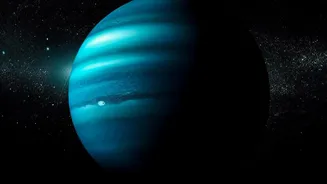
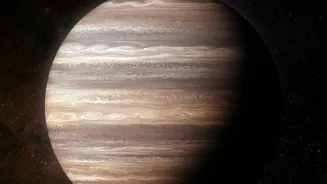
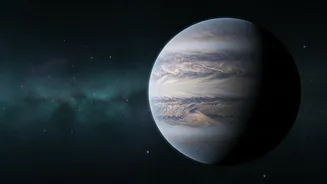
The newfound world, now named Beta Pictoris d, is a gas giant like its siblings. However, it's the smallest of the three, with about 2.4 times the mass of Jupiter, making it one of the lightest exoplanets ever to be directly imaged from Earth. It orbits its star much farther out than the other two planets, at a distance similar to that between Uranus and Neptune in our own solar system, taking about 91 years to complete one orbit. Because the Beta Pictoris system is so young, its planets are still hot from their formation; Beta Pictoris d has a surface temperature of about 325 degrees Celsius. The JWST team didn't just see a spot of light; they captured the planet's chemical fingerprint, detecting methane, carbon monoxide, and water vapor in its atmosphere. This discovery also helps solve a puzzle: the planet's mass and location perfectly explain the odd shape of the inner edge of the star's debris disk, which it gravitationally sculpts.
A New Way to Find Worlds
What makes this discovery so exciting is not just the planet itself, but how it was found. It highlights the power of re-analyzing old data with new tools and techniques. Beta Pictoris d is 100 times fainter than its sibling Beta Pictoris b and was lost in the glare of the star and its dusty disk. The teams found it using advanced instruments and methods that can separate a planet's faint light from its overwhelming surroundings. One team used spectroscopy to essentially ignore the dust and isolate the unique chemical signature of a planet's atmosphere. This success shows that countless other planets might be lurking, undiscovered, in data archives. As technology improves, astronomers can go on 'digital' treasure hunts, revealing worlds that have been hiding in plain sight for years. This method could revolutionize the search for exoplanets, especially with even more powerful telescopes coming online soon.