


A New Look at a Cosmic Classic
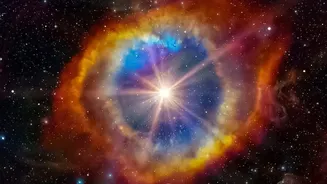
The subject of Webb’s latest portrait is a planetary nebula known as NGC 2392. While it has been famously imaged before by the Hubble Space Telescope and known by other nicknames like the Eskimo Nebula, this new view has solidified its more recent title:
the Lion Nebula. Located roughly 4,200 light-years away in the constellation Gemini, the nebula is the beautiful aftermath of a star, similar to our own Sun, reaching the end of its life. Where Hubble saw the object in visible light in 2000, Webb’s combined near- and mid-infrared instruments pierce through the glowing gas to reveal the complex and delicate structures of dust that were previously hidden. This allows astronomers to see not just the glowing gas, but the raw material being shaped and destroyed by the central star’s final, fiery breaths.
Anatomy of a Stellar Ghost
The nebula's striking appearance is a direct result of its central star's death throes. At the very center, appearing like a bright button nose, sits a white dwarf—the superheated, collapsed core of the original star. This stellar remnant is unleashing a torrent of intense radiation, effectively 'cooking' its surroundings from the inside out. This process has carved out a vast, cavernous bubble of ionized gas that forms the 'face' of the lion. As this bubble expands outward, it slams into the surrounding material, creating the intricate shells and filaments that Webb has now rendered with stunning clarity. Encircling this violent inner region is the cooler, sprawling shell of dust and gas that gives the nebula its signature 'mane'.
The Science Within the Mane
The headline feature of this new image is the remarkable detail within the dusty mane. Webb’s infrared sensitivity highlights dense, compact clumps of dust that have somehow managed to survive the blistering radiation from the central white dwarf. These resilient knots of material are more than just pretty features; they act as shields. By blocking the high-energy photons, they protect the dust and gas located directly behind them. This creates long, delicate, comet-like tails streaming away from the central star, a phenomenon now visible in exquisite detail. Studying these structures helps scientists understand the complex push-and-pull between a dying star's destructive energy and the survival of the very dust that forms future stars and planets.
A Fleeting Cosmic Masterpiece
For all its grandeur, the Lion Nebula is a fleeting moment in cosmic time. Planetary nebulae are temporary structures, representing a relatively brief phase in a star's evolution. The gas and dust that form this celestial artwork have been expanding and evolving for thousands of years, and they will continue to do so. The forces at play are constantly reshaping the nebula's appearance. Astronomers estimate that in about 10,000 years—a blink of an eye on an astronomical scale—the entire structure will have expanded and dissipated into space, its majestic form dissolving back into the interstellar medium. Webb's image, therefore, is not just a picture, but a snapshot of a dynamic and transient event, preserving a magnificent, temporary ghost.