
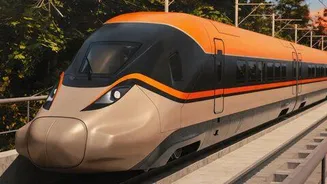
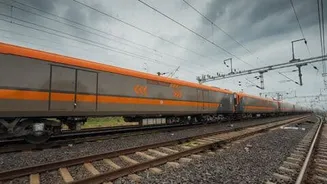
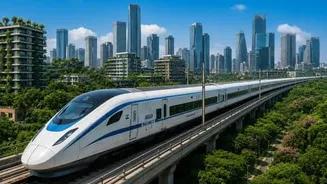
What 'Repeatable Design' Means
Instead of creating unique blueprints for every new corridor, Indian Railways is moving towards a 'kit of parts' approach. The National High Speed Rail Corporation Limited (NHSRCL) is developing a library of standardised designs for key infrastructure
elements. This includes everything from the massive viaducts that elevate the tracks, to bridges, tunnels, and even the station layouts. The goal is to create a common engineering framework that can be adapted and reused for future high-speed rail projects, creating a distinct identity for India's network. This strategy is based on the extensive experience gained from the country's first bullet train project, the 508-km Mumbai-Ahmedabad corridor.
The Blueprint: Learning from Mumbai-Ahmedabad
The Mumbai-Ahmedabad High-Speed Rail (MAHSR) project has served as a real-world laboratory for India. This pioneering corridor, being built with Japanese Shinkansen technology, involves complex engineering, including India's first undersea rail tunnel. The challenges faced and lessons learned in land acquisition, design, and construction have provided a valuable foundation. Realising that designing every corridor from scratch is time-consuming and expensive, officials are using the MAHSR experience to create a standardised Indian template for high-speed rail that suits local environmental and social conditions.
The Big Payoff: Speed, Scale, and Savings
The primary advantage of standardisation is acceleration. With ready-made, pre-vetted designs, the time taken from planning to construction can be significantly reduced. This approach also enables economies of scale; procuring materials and components in bulk for multiple projects can lead to substantial cost savings. Furthermore, having a uniform network simplifies maintenance, spare parts management, and the training of personnel. A consistent design for stations also improves the passenger experience, making navigation intuitive across the network. This model is seen as essential for managing the sheer scale of India's ambition: a planned network of seven new corridors covering nearly 4,000 kilometres.
Mapping the Future High-Speed Network
This new strategy is not just theoretical; it is being prepared for a slate of newly announced corridors. In the Union Budget 2026-27, seven routes were identified for the next phase of expansion. These include key arteries like Delhi-Varanasi, Mumbai-Pune, Pune-Hyderabad, and Chennai-Bengaluru, among others. Work has already begun on preparing Detailed Project Reports (DPRs) and finalising alignments for these lines. The standardised designs will be applied to these projects, with initial consultancy work focusing on the Delhi-Varanasi and Chennai-Bengaluru corridors, which feature complex elements like underground stations and long tunnels.
From Foreign Tech to 'Make in India'
While the first project relied heavily on Japanese technology, the push for standardisation is coupled with a strong 'Make in India' initiative. NHSRCL is collaborating with leading Indian technical institutes, like the IITs, to develop these standards. The aim is to create an indigenous high-speed rail ecosystem, reducing dependence on foreign systems. This extends to rolling stock, with plans for Indian companies to design and manufacture train sets capable of 250-280 kmph. India is also developing its own signalling protocol, the Bharat Train Control System (BTCS), to create a cost-effective and adaptable system for its future high-speed network.