





More Than Just a Moon Buggy
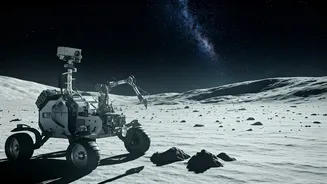
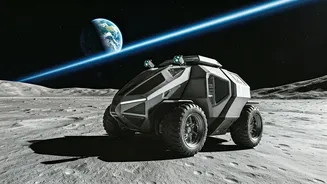
Forget the quaint, dune buggy-style rovers of the Apollo era. The new Lunar Terrain Vehicles (LTVs) NASA has commissioned are a different breed altogether. As part of the Artemis program, which aims to establish a sustainable human presence on the Moon,
these rovers are essential for exploring the challenging terrain of the lunar south pole. They will need to carry two astronauts in bulky spacesuits, transport scientific equipment, and collect samples over far greater distances than ever before. Unlike their predecessors, these LTVs are being designed as hybrid platforms that can be driven by astronauts or operated remotely from Earth, effectively serving as mobile science robots between crewed missions. This dual-use capability will allow for year-round scientific discovery on the lunar surface.
A New 'Services' Model for Space
Perhaps the most significant aspect of this announcement is the business model. Instead of buying and owning the rovers outright, NASA is acquiring them “as a service.” This means the agency is essentially hiring the companies to provide an end-to-end mobility solution, from development and delivery to the Moon to ongoing operations. This approach, formalized under the Lunar Terrain Vehicle Services (LTVS) contract, has a potential combined value of up to $4.6 billion over the next decade and beyond. It marks a major strategic shift, fostering a commercial marketplace on the Moon and allowing the chosen firms to use their rovers for their own commercial activities when not needed by NASA, paving the way for a future lunar economy.
The Contenders: Intuitive Machines
Houston-based Intuitive Machines is one of the three firms selected for the initial development phase. Already a key player in NASA’s commercial lunar landing services, the company is leading a team that includes some of the biggest names in aerospace and technology. Their rover concept, known as the Reusable Autonomous Crewed Exploration Rover (RACER), leverages partnerships with Boeing for system design, Northrop Grumman for systems integration, and even Michelin for advanced tire technology. The team is designing a vehicle roughly the size of a pickup truck, capable of handling heavy cargo and equipped with a robotic arm for complex tasks.
The Contenders: Lunar Outpost
Colorado-based Lunar Outpost is bringing automotive might to the Moon. The company is leading a team called Lunar Dawn, which includes aerospace giant Lockheed Martin and, crucially, automotive titans General Motors and Goodyear. This partnership aims to transfer decades of experience in building rugged, reliable terrestrial vehicles to the lunar environment. GM is contributing its Ultium electric vehicle battery technology, while Goodyear is developing airless tires capable of withstanding the Moon's extreme temperatures and abrasive dust. Their vehicle, named Pegasus, is designed as a true off-road machine for exploring and working on the lunar surface.
The Contenders: Venturi Astrolab
The third competitor, California's Venturi Astrolab, is offering a uniquely versatile design with its Flexible Logistics and Exploration (FLEX) rover. Conceived as a modular mobility platform, the FLEX rover is designed like a flatbed truck for the Moon, capable of carrying a wide variety of payloads. Its modular design allows it to transport and deploy everything from scientific instruments to construction materials. One of its standout features is a set of hyper-deformable wheels designed to absorb the shock of rough terrain while resisting the harsh lunar environment. Astrolab is teamed with Axiom Space, a leader in commercial space stations, to ensure its rover is ready to support a human presence.
Building for a Hostile World
The development of these rovers is a monumental engineering challenge. All three designs must be able to operate in the extreme conditions of the lunar south pole, where temperatures can swing by hundreds of degrees, from scorching sunlight to the deep freeze of permanently shadowed craters that can reach -230°C. They will require advanced power management systems to survive and operate during long, dark lunar nights and state-of-the-art navigation and autonomous driving capabilities to traverse hazardous, crater-filled landscapes safely. NASA's selection of three competing firms ensures a race to solve these problems, accelerating innovation and increasing the chances of success for the Artemis missions.